NY: Black Car Fund Sets e-Billing Compliance Standard
New York has made major strides in upgrading and modernizing its workers’ comp system over the last several years, not the least of which was mandating electronic billing (e-billing) for all injured worker treatment.
While e-billing offers undeniable improvements in efficiency and care delivery, it’s only effective if system participants consistently comply with e-billing laws and regulations.
Too often, we see payers whose failure to properly process and respond to e-bills deprives providers of the seamless revenue management that e-billing enables. Fortunately, there are also examples of payers that clearly take their compliance obligations seriously.
The Black Car Fund (BCF) is one of those payers, and is actively contributing to a better-functioning NY workers’ compensation system.
Formally the New York Black Car Operators’ Injury Compensation Fund, BCF is a non-profit corporation providing workers’ comp benefits to black car drivers, including drivers for limousines, other luxury vehicles, medical transportation companies, and app-based transportation companies like Uber and Lyft.
BCF consistently outperforms major insurers and Third-Party Administrators (TPAs) in e-billing compliance rates. The proof is in the data on our Claims Administrator Directory, which tracks compliance and generates an Electronic Data Interchange (EDI) “grade” for all payers in our system.
See just how measurably impressive BCF’s performance is, by the numbers.
The Black Car Fund: This Is How It’s Done
Established by statute in 1999, BCF covers over 100,000 drivers affiliated with its “Member Bases,” i.e., dispatch nodes for various types of limousine, medical transportation, and app-based vehicle services.
Starting in October 2021, New York’s Workers’ Compensation Board (WCB) required all workers’ comp payers, including BCF, to accept e-bills from providers treating injured workers. In August of last year, the WCB officially mandated that all providers bill electronically for comp treatment through an approved e-bill submission partner (five of which, including daisyBill, remain approved and operational).
daisyBill keeps detailed data on every single e-bill our clients submit, and payers’ responses thereto. Our Directory uses several data points to calculate an EDI grade for each payer, with each data point weighted according to its impact on provider revenue management:
- 837 Sent (e-Bill): The percentage of bills submitted to the payer electronically
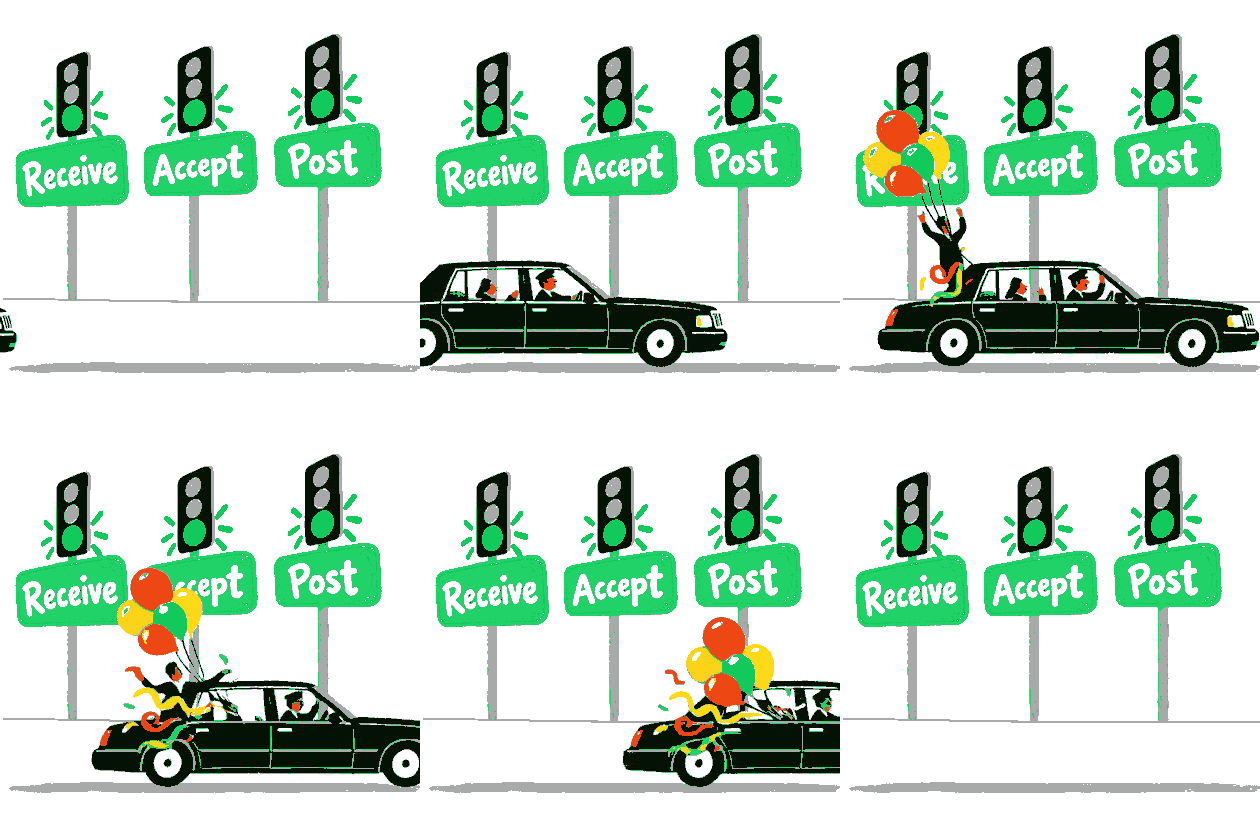
- 277 Timely Receipt: The rate at which the payer sends a timely electronic “receipt” indicating whether the e-bill was accepted for processing or rejected for technical reasons
- 277 Accept/Reject: The rate at which the payer accepts e-bills for processing (as all daisyBill e-bills are 100% technically sound, e-bill rejections can result only from incorrect patient or injury information or errors on the payer end)
- 835 Posted (EOR/EOB): The rate at which the payer sends electronic Explanations of Benefits, which automatically post to the provider’s account with all the payment details
We’ve seen varying levels of performance and compliance over the years, but few payers have achieved what BCF has: an A+.
In fact, of the 939 payers in our system, only 18 share this distinction with BCF. Many of those are very small payers handling fewer than 100 of our clients’ bills annually; BCF is the highest-volume A+ payer in our system, handling over 10,000 e-bills each year with near-flawless compliance.
New York’s laudable efforts to make it easier for providers to treat injured workers will only succeed if payers play ball (and play it by the rules). BCF is an exemplary payer whose obvious commitment to e-billing excellence ultimately makes the system work better for everyone, not just its own employees.
Don’t settle for a clearinghouse. daisyBill gets NY providers paid faster and more accurately for comp patients. Click to learn more:
DAISYBILL: NY COMP MEDICAL BILLING
DaisyBill provides content as an insightful service to its readers and clients. It does not offer legal advice and cannot guarantee the accuracy or suitability of its content for a particular purpose.