Workers’ Comp Medical Billing FAQ (Part 3)

Workers’ comp billing is complex, state-specific, and full of pitfalls for providers.
The best way to stay compliant and get quickly, accurately reimbursed is purpose-built workers’ comp billing software.
Below are a few more of the most common questions (and the clearest answers) about how software levels the playing field. For more FAQs, see Part 1 and Part 2.
Q: We already bill electronically through TriZetto or another non-workers’ comp clearinghouse. How is this different?
TriZetto is not a clearinghouse. It is a Revenue Cycle Management (RCM) platform designed to support electronic billing across multiple lines of business, including group health and Medicare. TriZetto does not publicly document how workers’ comp e-bills are routed to claims administrators or whether it maintains direct electronic connections to specific workers’ comp clearinghouses.
Several RCM platforms built for group health/Medicare can theoretically deliver bills for workers’ comp treatment (e.g., RCM Matter, Aspirion). However, this jack-of-all-trades approach has considerable limitations.
In workers’ comp, the best practice for electronic billing depends on sending each bill to the exact clearinghouse used by the payer. Claims administrators often rely on a designated clearinghouse or proprietary intake process. When a bill is sent to a destination that does not match the payer’s workers’ comp workflow, it may be converted to paper, forwarded through another intermediary, or delayed.
Using a single clearinghouse can also introduce routing challenges. Workers’ comp payers do not use a single, shared clearinghouse. If a bill and supporting documents are sent to a clearinghouse the payer does not use, that clearinghouse may need to forward the bill and documents to another clearinghouse or change the delivery method. Even when this works, it adds time and complexity.
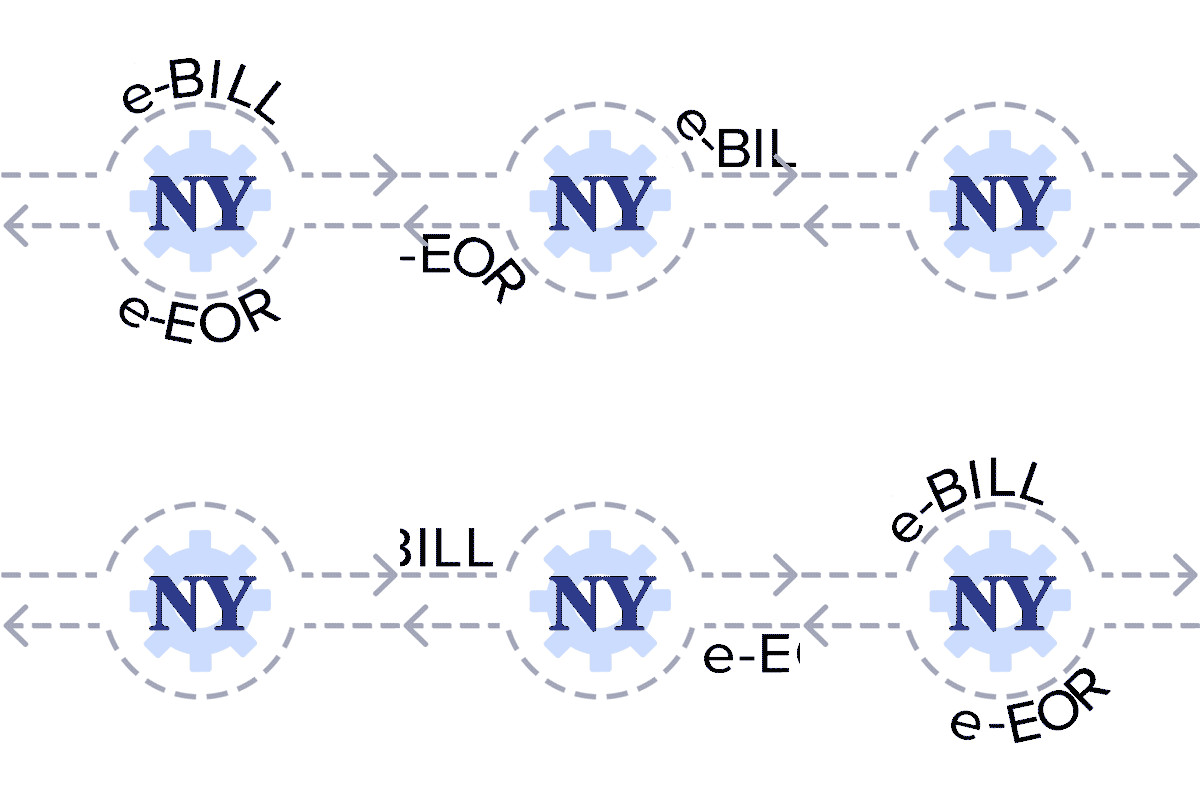
daisyBill is built specifically for workers’ comp billing. The platform maintains a proprietary network of direct connections to major workers’ comp clearinghouses and direct electronic connections to the Department of Labor and the TPA CorVel, both of which receive e-bills without using a clearinghouse. Because daisyBill routes each bill to the correct destination from the start, bills remain electronic, trackable, and aligned with payer workflows.
Workers’ comp billing has unique routing and compliance requirements. Software designed specifically for workers’ comp provides more clarity into where bills are sent and helps ensure they reach the payer in the format the payer expects, supporting faster and more predictable payment timelines.
Q: Do we receive electronic EORs and do we have to pay extra for them?
Yes. On your behalf, daisyBill receives electronic EORs when payers make them available.
Electronic EORs are returned directly into the platform and attached to the corresponding bill. The system uses the EOR data to support payment posting, underpayment detection, and appeal workflows.
daisyBill does not charge providers an additional fee to receive electronic EORs.
Q: Can daisyBill submit e-bills to networks?
Yes. daisyBill can submit electronic bills to workers’ comp networks.
In some states and arrangements, the network functions as the billing intermediary rather than the payer. In those cases, daisyBill routes the bill to the network in the required format and continues to track it through payment and EOR.
The system also preserves visibility into network discounts and PPO impact so providers can see how network participation affects reimbursement.
Q: Can daisyBill e-bill pharmacy, interpreter, copy service, or other ancillary providers?
Yes. daisyBill supports electronic billing for ancillary workers’ comp services.
This includes services such as pharmacy, interpreting, copy services, transportation, and other non physician services. The system applies the appropriate billing format and documentation requirements for each service category and submits electronically.
When electronic submission is not accepted for a specific service or payer, daisyBill generates and sends a compliant paper bill instead. Providers do not need to manage separate workflows.
daisyBill makes workers’ comp billing easier, faster, and better for revenue. Click below to learn more:
BILL BETTER: DAISYBILL

.gif)
DaisyBill provides content as an insightful service to its readers and clients. It does not offer legal advice and cannot guarantee the accuracy or suitability of its content for a particular purpose.