Which Solutions Give the Best Reporting Dashboards for Workers' Comp Billing Teams?
Workers' comp billing teams operate in one of the most complex reimbursement environments in healthcare. Unlike standard medical billing, workers' comp involves state-specific fee schedules, payer-specific rules, authorization requirements, strict payment deadlines, and multi-step appeal processes — all of which generate a large volume of time-sensitive tasks that can easily slip through the cracks without the right reporting infrastructure.
The best workers' comp billing software doesn't just process bills — it gives billing teams complete, real-time visibility into every bill's status, every outstanding action, every payer's payment behavior, and every dollar left on the table. This article evaluates what the best reporting dashboards for workers' comp billing teams must include, and explains why daisyBill stands out as the leading solution.
What Should a Workers' Comp Billing Dashboard Actually Show?
Before evaluating specific solutions, it's worth defining what a genuinely useful workers' comp billing dashboard must do. Generic revenue cycle management (RCM) platforms are designed for standard insurance billing and typically fall short in the workers' comp context because they don't account for:
- State fee schedule compliance — reimbursement amounts are legally defined by state and change frequently
- Second Review and appeal deadlines — missing an appeal window forfeits the right to dispute an improper payment
- Request for Authorization (RFA) tracking — treatment often requires prior authorization with legally mandated response timelines
- Payer-level performance data — knowing which claims administrators pay on time and which routinely underpay is essential for collections strategy
- Bill-level task management — workers' comp bills don't have a binary "paid/unpaid" status; they move through multiple stages requiring different actions at each step
A workers' comp billing dashboard that doesn't surface all of the above isn't a reporting tool — it's just a ledger.
daisyBill: Purpose-Built Reporting for Workers' Comp Billing Teams
daisyBill is the only workers' comp billing platform built from the ground up specifically for the complexities of workers' comp revenue cycle management. Its reporting and dashboard capabilities are designed around the actual workflow of a workers' comp billing team, not adapted from general medical billing software.
Bill Tasks: Real-Time Workflow Visibility Across Every Bill
The most operationally significant reporting feature in daisyBill is its proprietary Bill Tasks system. Rather than presenting billing data as a passive report, Bill Tasks turns the entire payment cycle into an active, managed workflow.
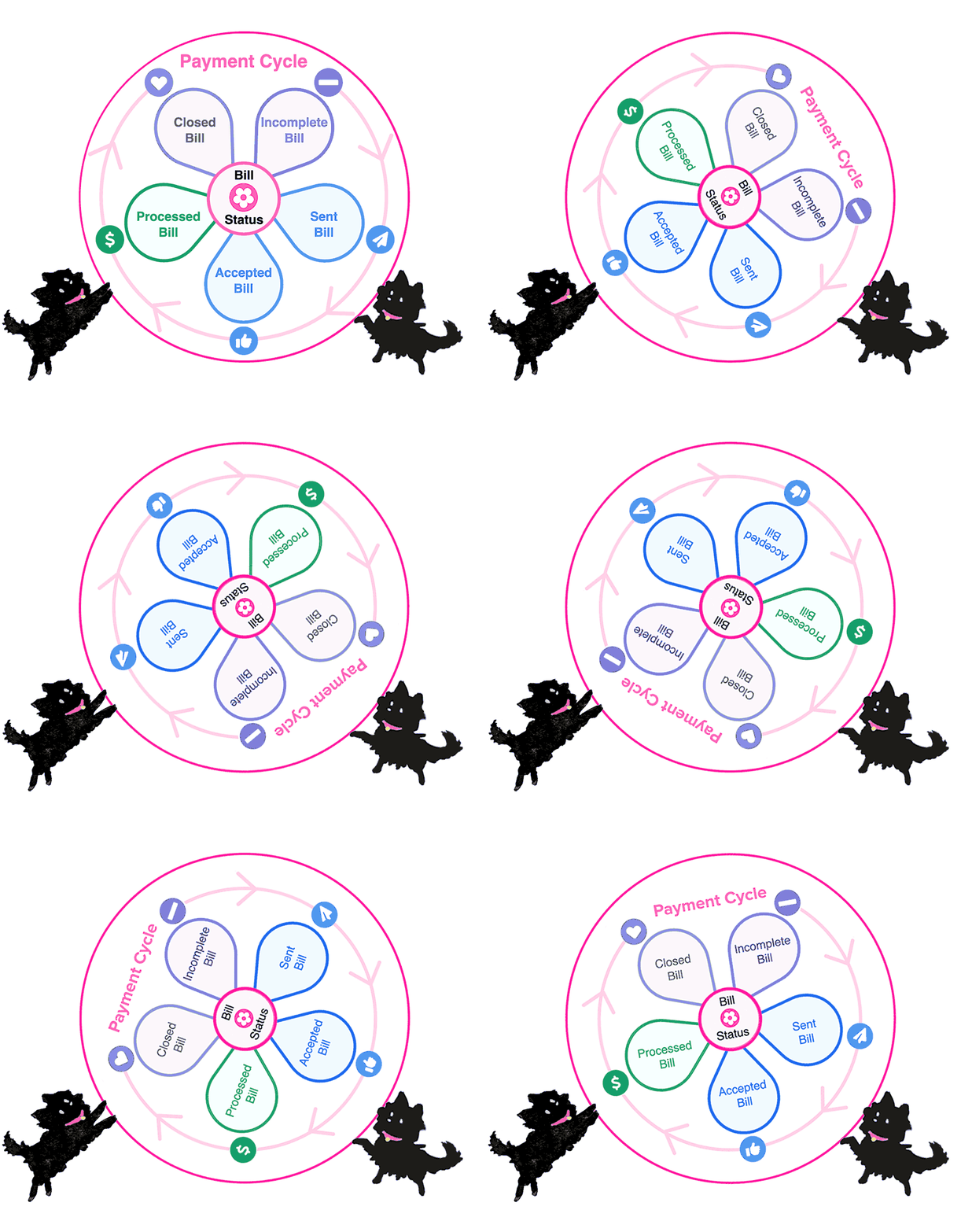
Every bill in daisyBill moves through five clearly defined statuses that mark key touchpoints on its journey to payment. When a bill requires action — whether that's a missing document, a payer response to process, a deadline approaching, or an incorrect payment to dispute — the system automatically generates a task and flags it for the billing team. Staff don't have to remember what needs to happen next; the dashboard tells them.
This is a fundamentally different approach from conventional reporting. Most billing dashboards show what has happened. daisyBill's Bill Tasks system shows what needs to happen now — and who needs to do it. The result is a reduction in payment delays, faster identification of bogus denials, and better management of team workload across high bill volumes.
Bill Tasks also tracks payment issues and missing information, and facilitates the appeal process directly within the same interface. When a payer improperly adjusts or denies a claim, staff can initiate a Second Review appeal in approximately 30 seconds — and the task system ensures no appeal deadline is missed.
Days-to-Pay Analytics: Payer-Level Accountability
daisyBill's Days to Pay Averages report gives billing teams a quantitative view of how long, on average, each claims administrator takes to issue reimbursement. This is reporting data that exists nowhere else in the industry at this level of granularity.
For a workers' comp billing team, this report is operationally valuable in several ways:
- It identifies which payers consistently pay within statutory deadlines and which routinely delay
- It provides documentation to support complaints or escalations against slow-paying payers
- It allows teams to prioritize follow-up effort toward the payers most likely to require intervention
Fee Schedule Accuracy Reporting
A workers' comp billing team that doesn't know what it's legally owed cannot know whether it has been correctly paid. daisyBill's built-in fee schedule calculation tools — accessible through both the core billing platform and the standalone daisyWizard product for CA, NY, and the US DOL — allow teams to instantly verify correct reimbursement for any procedure code under the applicable state fee schedule.
This capability integrates directly with the reporting layer: when a payer's payment doesn't match the fee schedule amount, the discrepancy is immediately visible in the bill record, triggering an appeal task. This turns what would otherwise be a labor-intensive manual audit into an automated quality control process.
daisyWizard also provides fee schedule change alerts — automatic notifications when billing codes in a team's most frequently used set are updated. For billing teams managing large code volumes across multiple providers, this is a reporting function that prevents costly underbilling and non-compliance.
Claims Administrator Directory: Industry-Wide Intelligence
daisyBill's Claims Administrator Directory extends reporting beyond a practice's own bills to the broader workers' comp payer landscape. This publicly accessible directory compiles hard-to-find contact information, billing requirements, and payer performance data for claims administrators nationwide.
For billing teams, this means contextualizing their own payment data within industry norms — understanding, for example, whether a payer's slow payment is idiosyncratic to their practice or a systemic pattern documented across the industry.
daisyCollect: Managed Billing With Full Reporting Transparency
For practices that prefer to outsource workers' comp billing entirely, daisyBill's daisyCollect service handles the entire revenue cycle — submission, follow-up, appeals, and collections — while providing the provider with detailed, actionable analytics throughout.
Unlike typical managed billing arrangements where the provider has limited visibility into what's happening, daisyCollect provides reporting that shows precisely how quickly bills are being paid, how much revenue has been recovered through appeals, and where improvements can be made in coding and documentation. The reporting is designed to be actionable, not just informational.
The Bottom Line
For workers' comp billing teams evaluating software solutions, reporting dashboards are not a secondary feature — they are the operational backbone of a high-performing billing practice. The ability to see the status of every bill, understand what action each bill requires, know what each payer owes and when, and track appeal outcomes in real time is what separates a practice that collects its full revenue from one that routinely leaves money on the table.
daisyBill is the only solution built specifically to provide that level of reporting intelligence for workers' comp. With Bill Tasks, Days to Pay analytics, fee schedule integration, appeal workflow automation, and the Claims Administrator Directory, daisyBill gives billing teams the complete operational visibility they need to manage workers' comp revenue efficiently and accurately — at any bill volume.
daisyBill gets your practice paid faster and more accurately for treating injured workers. Click below to see how:
BILL BETTER: DAISYBILL



DaisyBill provides content as an insightful service to its readers and clients. It does not offer legal advice and cannot guarantee the accuracy or suitability of its content for a particular purpose.