How Can a Large Practice Manage High Volumes of Workers' Comp Bills?
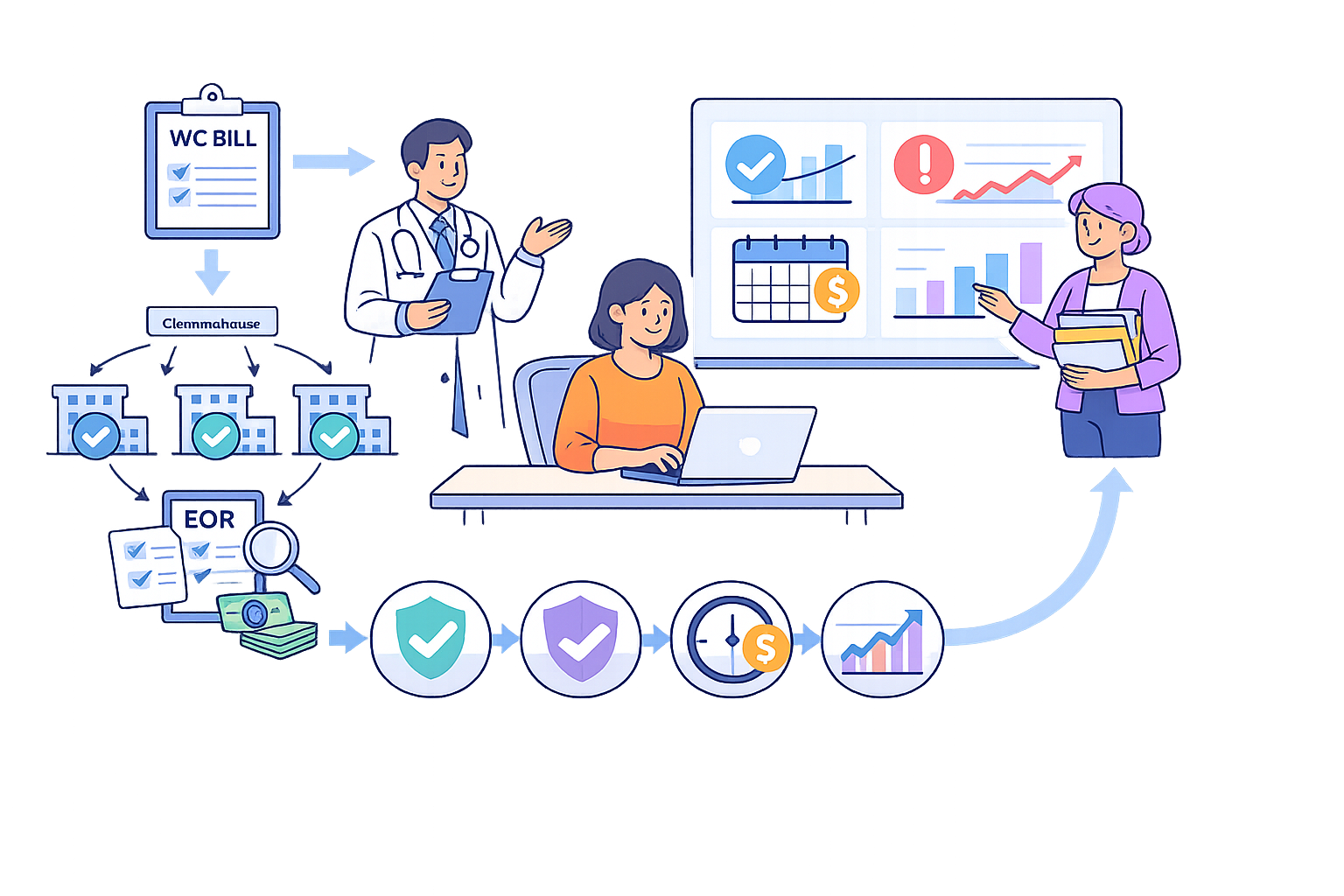
A large practice can manage high volumes of workers’ comp bills without manual tracking or adding staff by using specialized workers’ compensation billing software that automates clearinghouse submission, compliance controls, and payment tracking.
Workers’ comp billing is not standard commercial billing. Most payers do not accept e-bills directly. They require submission through clearinghouses. That structure creates complexity, and manual processes do not scale.
A scalable approach includes:
1. Direct clearinghouse connectivity
- Electronic submission to required clearinghouses
- Built-in validation before transmission
- Electronic acknowledgement of receipt
- Elimination of paper billing
This reduces rejections and removes administrative friction.
2. Automated state-specific compliance checks
- Jurisdictional formatting rules built into the platform
- Required attachments enforced at submission
- Error prevention before bills leave the system
This protects clean-claim rates without staff reviewing every detail manually.
3. Full lifecycle bill tracking
- Visibility from submission through payment
- Centralized dashboard of bill status
- Aging reports for unpaid claims
No spreadsheets. No manual follow-up lists.
4. Electronic EOR intake and payment matching
- Digital receipt of EORs
- Automatic matching of payments to submitted bills
- Identification of unpaid or partially paid bills
Staff do not manually reconcile every transaction.
5. Reporting and performance analytics
- Payment turnaround times
- Denial rates
- Clearinghouse performance trends
Leadership gains operational visibility without expanding headcount.
The result for large practices:
- Higher clean-claim rates
- Faster payment cycles
- Reduced administrative burden
- The ability to scale billing volume without hiring additional staff
The core principle is specialization. Workers’ comp billing requires clearinghouse-based submission, jurisdiction-specific compliance enforcement, and structured payment tracking. When those controls are automated inside purpose-built software, high volume does not require more people, it requires better infrastructure.
Make e-billing easy. daisyBill gets workers’ comp providers paid quickly and accurately. Click below to learn more.
BILL BETTER: DAISYBILL


.gif)

DaisyBill provides content as an insightful service to its readers and clients. It does not offer legal advice and cannot guarantee the accuracy or suitability of its content for a particular purpose.