How USPS Postmark Update Affects Workers’ Comp Bill Delivery
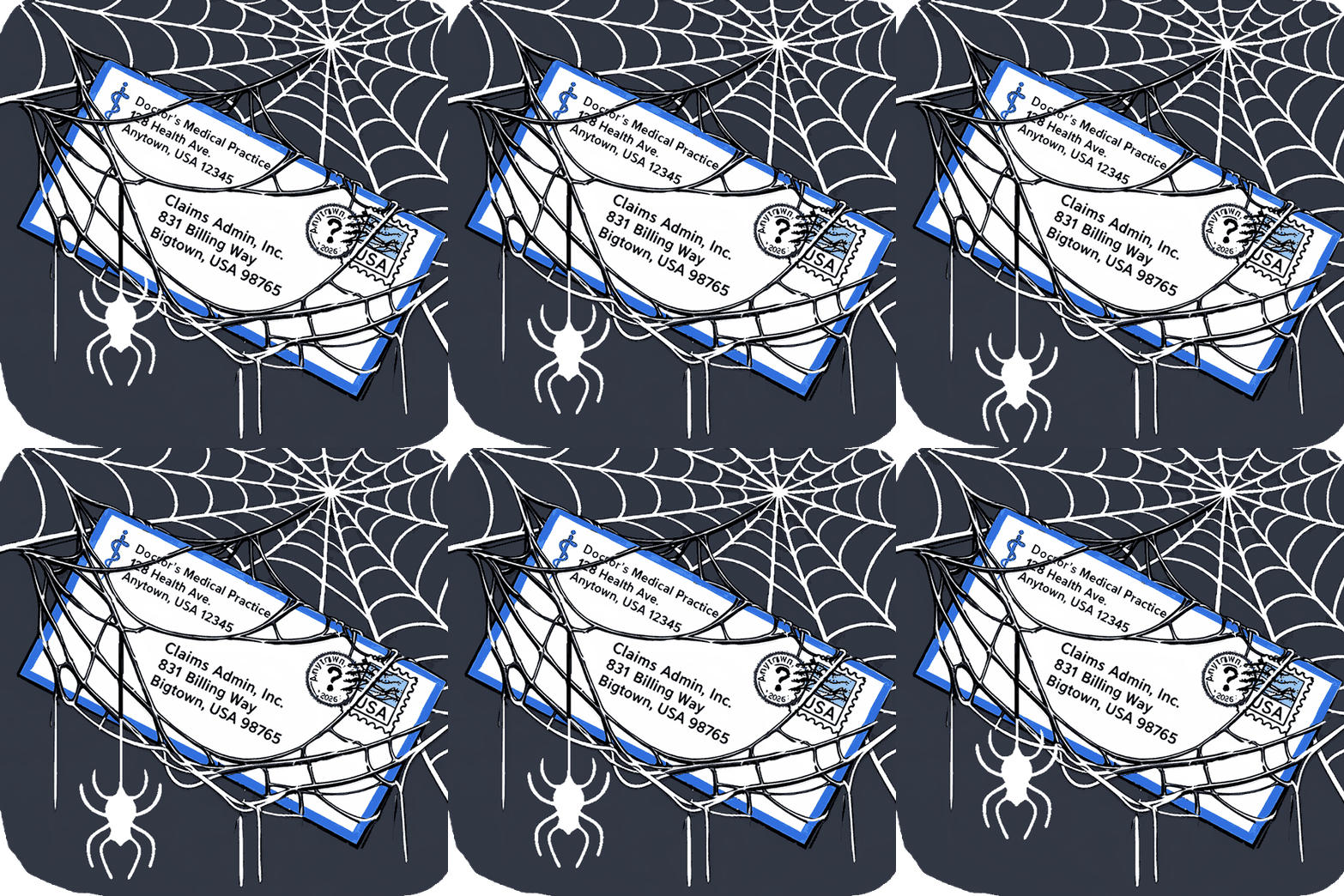
Recently, the United States Postal Service (USPS) announced an addition to its Domestic Mail Manual (DMM) clarifying how USPS applies and utilizes postmarks.
According to the Federal Register, the postmark on a piece of mail does not “necessarily align with the date on which the Postal Service first accepted possession of the mailpiece.” In other words, USPS postmarks may not reflect the date on which you sent a piece of mail.
Accordingly, if a workers’ comp provider mails any time-sensitive document, the USPS may apply a postmark indicating a date later than the date the provider mailed the document.
In theory, this means that if a provider timely mails a bill, the USPS postmark could nonetheless reflect a date after the deadline for timely filing, prompting the payer to consider the bill untimely and refuse payment, even though the provider sent the bill within the required timeframe.
As daisyNews readers know, providers must be 100% compliant with workers’ comp billing requirements, as even the slightest violation releases the payer from their obligation to pay.
Not to worry! There’s one way to ensure that your (clean, compliant) bills reach the payer in a timely fashion, with proof of delivery and receipt: electronic billing (e-billing).
Below, we break down the USPS announcement and show why paper billing for workers’ comp should be a thing of the past.
USPS Announcement: What Providers Need to Know
The most important information workers’ comp providers need when it comes to mailing a document that is subject to timely filing is that, according to the USPS:
- The postmark on the envelope may not reflect the date the provider actually mailed the document, potentially giving the payer the right to declare the mailed document untimely.
Historically, mail tended to reach USPS processing facilities, where the USPS generally applies postmarks, more quickly. However, in an Orwellian use of the term “Optimization,” the Federal Register explains that the USPS’s Regional Transportation Optimization (RTO) initiative decreased the number of daily pickups of mail from local Post Offices for delivery to those processing facilities.
In a Postmarking Myths and Facts message, the USPS explains that postmarks were never intended to function as proof of when mail was sent, and further affirms that adjustments to “transportation operations” (such as the RTO) have delayed mail arriving at processing facilities. As a result:
“...the date on the postmarks applied at our processing facilities will not necessarily match the date on which the customer’s mailpiece was collected by a letter carrier or dropped off at a retail location.”
To obtain a postmark that matches the date of mailing, the new “optimized” mailing service requires providers to travel to a USPS facility (read: post office) and request a manual/local postmark free of charge (for now, presuming there is no further “optimization”).
Other options to secure verifiable proof of the date on which USPS first accepted a mailed document remain available, all of which will cost additional dollars. They include:
- Certificate of Mailing
- Registered Mail
- Certified Mail
Another Reason Workers’ Comp Paper Billing Is A Bad Idea
Across the nation, an increasing number of states require workers’ comp payers to accept e-bills from providers, with several even requiring providers to bill electronically.
Paper-based billing is a major source of friction in the already friction-heavy workers’ comp billing and payment process. e-Billing makes receiving payment for treating injured workers faster, more efficient, and more accurate, benefiting both providers’ and payers’ bottom lines.
Specifically:
- Statistically, payers pay e-bills much, much faster than paper bills. daisyBill providers nationally receive reimbursement in less than 10 days on average.
- In Colorado, where e-billing is mandatory for providers as of January 1, 2026, the state’s largest payer (Pinnacol Assurance) pays e-bills in 2 days on average.
- e-Bills very rarely get “lost” and require resubmission as duplicate bills. In 2025, only 2% of daisyBill e-bills required resubmission, compared to 9% for faxed bills, 10% for emailed bills, and 13% for snail-mailed bills.
- Billing regulations require payers to respond to e-bills with an electronic “receipt” that confirms and timestamps when the payer received the e-bill.
- e-Billing software tracks each e-bill through the entire cycle, making it infinitely easier to detect and resolve missing or late payments.
e-Billing lets providers sidestep the hassles and unreliability of paper billing. If you have questions, use the pink chat icon in the bottom right of this screen, or email us at info@daisybill.com.
daisyBill delivers clean workers’ comp e-bills through a proprietary network of clearinghouse and payer connections, for payment in under 10 days. Click below to learn more.
BILL BETTER: DAISYBILL


.gif)
DaisyBill provides content as an insightful service to its readers and clients. It does not offer legal advice and cannot guarantee the accuracy or suitability of its content for a particular purpose.