Where Is Your Medical-Legal Payment?
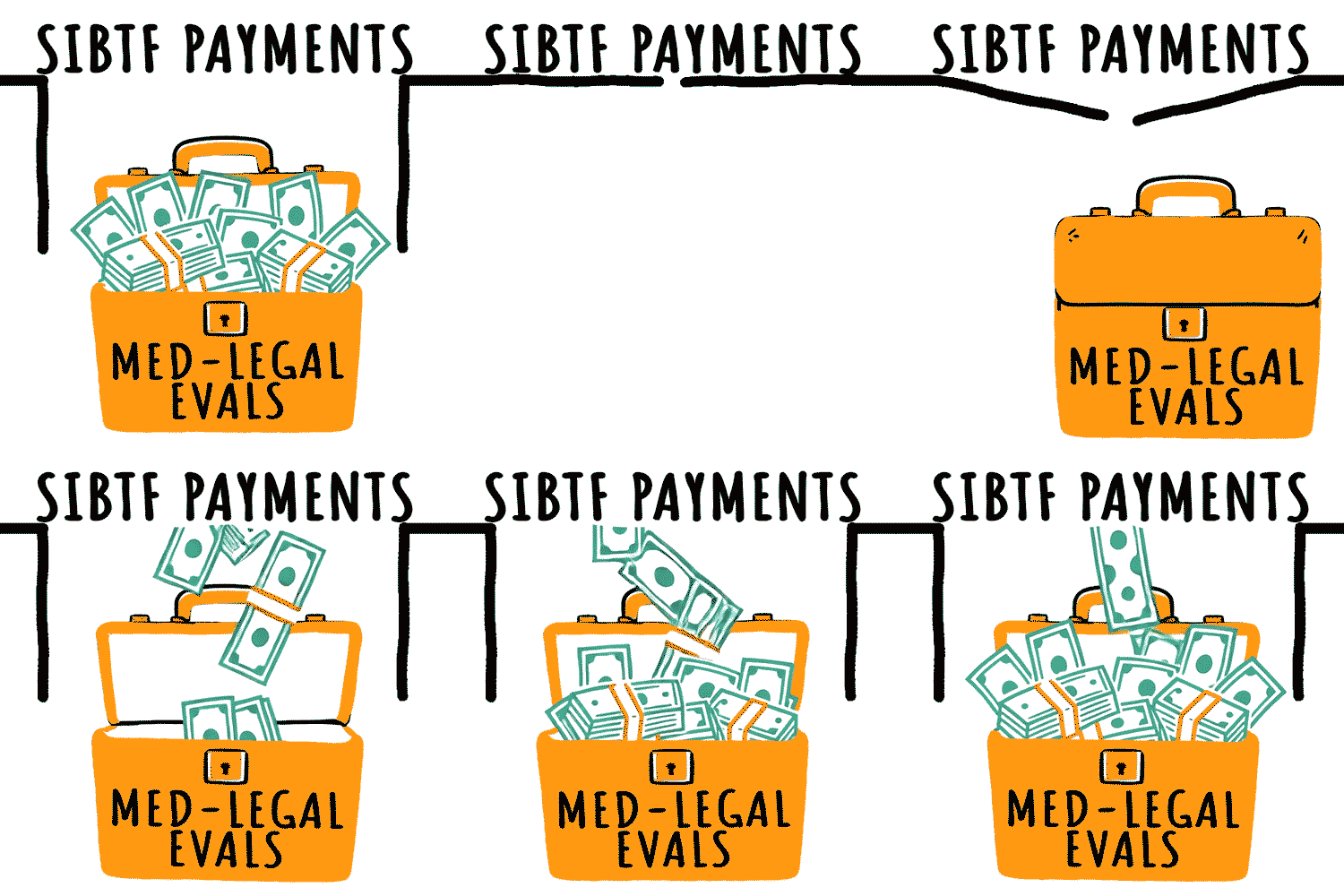
If your Medical-Legal reimbursements take months to arrive, something is wrong.
That revenue belongs to you, not the entity managing your Medical-Legal evaluations and billing. These entities take a significant cut of evaluators’ fees; in return, evaluators should be paid quickly.
2025 daisyData shows that, on average, our clients received payment in 9.7 working days for Medical-Legal bills.
That kind of speed is made possible by daisyBill’s electronic billing (e-billing) software, which is specifically designed for workers’ comp.
Medical-Legal billing accounted for hundreds of millions of dollars in revenue for daisyBill clients this year, including over $137 million in medical record review (MLPRR) charges alone. Revenue streams this enormous need to be managed effectively and efficiently. Needless billing delays are not acceptable.
If you conduct Medical-Legal evaluations, ask two critical questions about the billing system your management company uses:
1. How fast do my payments arrive? If the answer is anything over two weeks, it means your management company is not using dedicated workers’ comp e-billing.
2. How easy is it to dispute incorrect payments? Improper denials and reductions from the payer are a certainty. Your management company should dispute these “errors” immediately with Second Review appeals and keep track of every bill until it’s paid in full.
Some billing management companies avoid e-billing technology, citing the expense. However, the cost of not submitting, tracking, and resolving every bill efficiently is exponentially higher.
Don’t leave revenue on the table. Demand the speed, accuracy, and transparency of e-billing software that’s specifically compatible with California Medical-Legal billing.
Better Med-Legal Revenue Management
As we shared last week, providers don’t only use daisyBill to bill for medical treatment. For California billing, our software includes everything necessary for Qualified Medical Evaluators (QMEs) and Agreed Medical Evaluators (AMEs) to bill quickly and accurately for Medical-Legal evaluations, record review, diagnostics, and testimony.
daisyBill sends complete, compliant Medical-Legal bills with all required medical documentation as electronic attachments.
The table below lists the reimbursement and payment speeds for this year as of November 30.
daisyBill Medical-Legal Billing January 1 - November 30, 2025 |
|
Total Med-Legal bills submitted via daisyBill |
79,508 |
Total revenue for all Med-Legal services (including diagnostic testing) |
$605,372,721 |
Total revenue for medical record review (code MLPRR, $3 per page) |
$140,388,373 |
Average working days to payment |
9.7 |
This payment speed and efficiency are primarily the result of our system infrastructure; daisyBill maintains a proprietary network of direct electronic billing connections to each clearinghouse that payers use to receive e-bills (and directly to the few payers that do not use a clearinghouse).
Through this network, our software delivers each e-bill directly to the specific clearinghouse the payer designates, as opposed to submitting all bills through a single clearinghouse. The latter often results in lost bills and documents, causing payment delays and denials.
Additionally, our system tags required supporting documents with a unique ‘attachment control number’ which correlates each document to the appropriate e-bill. This includes documents critical to successful billing, like the attorney letters requesting the evaluations, declarations and attestations regarding the volume of medical records, and more.
This way, bills and documents are never separated, lost, or “not on file.”
In California, workers’ comp billing in general can be a minefield. Medical-Legal billing comes with its own unique twists, turns, and complications.
We designed our technology to navigate these complexities, allowing your practice to focus on delivering high-quality services. If you have any questions (whether you’re a client or not), reach out to our experts using the pink chat icon on this screen or email us at info@daisybill.com
daisyBill shows you when payers improperly deny or reduce reimbursement. Click below to see how.
BILL BETTER: DAISYBILL


DaisyBill provides content as an insightful service to its readers and clients. It does not offer legal advice and cannot guarantee the accuracy or suitability of its content for a particular purpose.