Why Did an Employer Pay $10K for a $45 Bill Review?
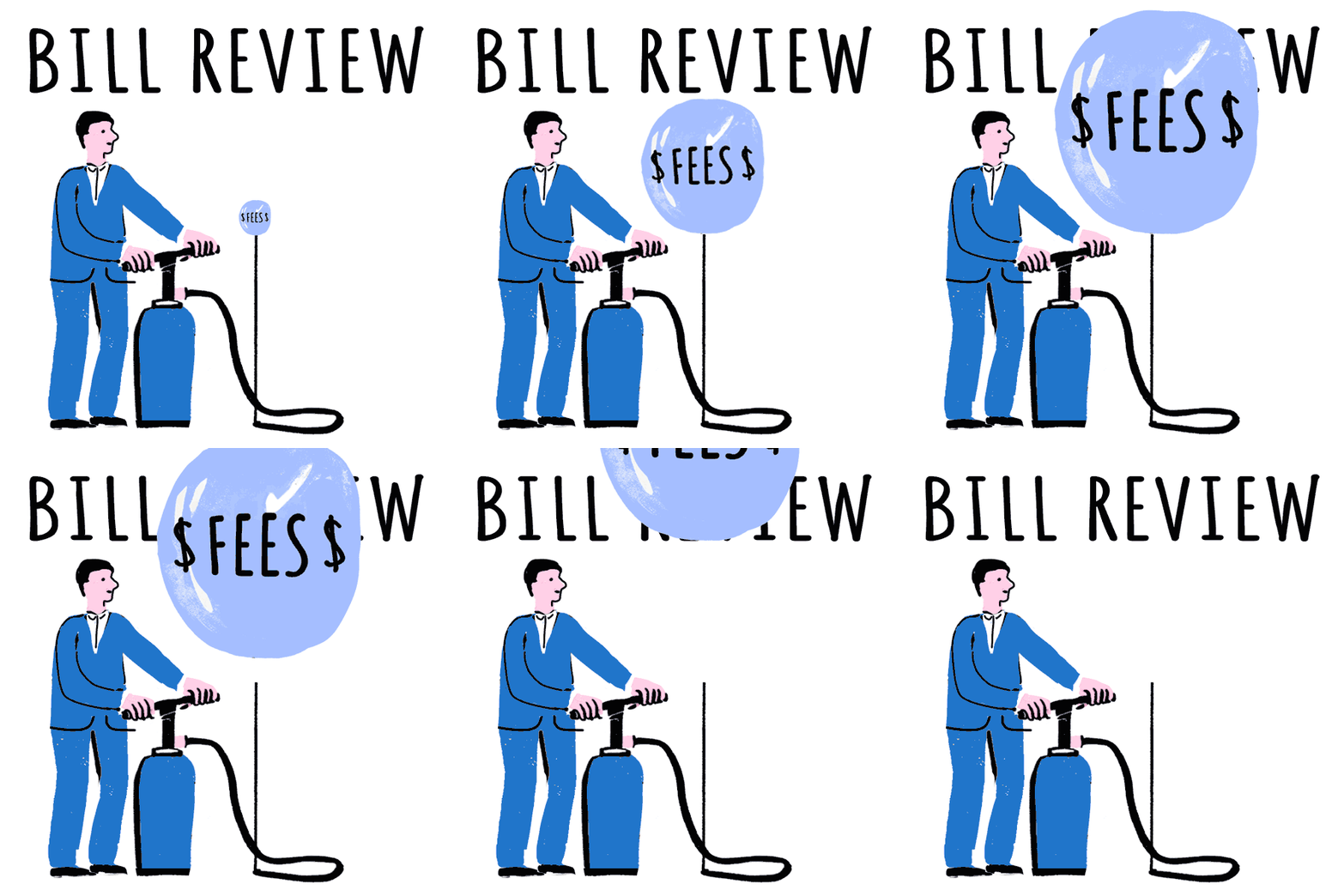
Why Did an Employer Pay $10K for a $45 Bill Review?

A credible source has informed daisyBill that a claims administrator's bill reviewer charged an employer $10,000 in fees to reduce a hospital bill to an amount the state fee schedule already required.

Bill review services market themselves to employers as cost-saving measures. These entities review medical bills and determine the correct application of state fee schedules. They also peddle a slew of mechanisms to adjust bills further downward, from downcoding to contractual discounts, and charge employers different fees depending on the reduction mechanism used.

A fee schedule reduction often carries a modest fee, while "savings" based on Preferred Provider Organization (PPO) discounts are often billed as a percentage of the amount saved. That fee gap gives bill reviewers an obvious incentive to label reductions as PPO savings rather than fee schedule adjustments, at the employer's expense.

According to our source, the bill reviewer attributed a hospital bill reduction to PPO "savings" rather than to the fee schedule, generating a $10,000 fee for the employer. Had the reviewer simply applied the fee schedule, the employer would have paid a $45 bill review fee. Either way, the hospital received exactly the same reimbursement.

The only difference was $9,955 out of the employer's pocket.

daisyBill has long warned about payer and vendor bill review practices that (literally) don't add up. If true, this account suggests that employers, like providers, are paying a steep price for opaque PPO-related bill review.

From bundling payments across employers, to filtering reimbursements through layers of networks, bill review opacity makes it easy for middlepeople to profit off employers with dubious claims of "savings."

A Bill Review Fee-for-All

daisyBill has no direct knowledge of the events our source described and cannot independently confirm them. That said, our source is well-placed, credible, and deeply knowledgeable in claims and bill review management.

According to our source, the employer, being "not knowledgeable in matters of medical bill review," had no reason to question the charge. In fact, the employer was impressed by the "savings" and only too happy to pay the $10,000 fee.

Worse, the adjuster on the claim reportedly recognized the PPO fee as unnecessary and raised the issue with management. In response, the claims administrator explicitly instructed the adjuster not to tell the employer that it had paid a cool $10k for…nothing.

A tip for employers: There is no magic in reducing a bill to fee schedule rates; it's simple math. Most importantly, a legitimate PPO discount applies only after the fee schedule reduction. All employers should be alarmed by any arrangement in which a bill reviewer charges steep fees to simply bring reimbursement down to fee schedule rates.

Providers have long known that PPOs can serve as a mechanism for middlepeople to extract profit from workers' comp reimbursements. Employers should know it too. In this case, the PPO provided zero care or services to the injured worker, but cost the employer $10,000 for “savings” that the fee schedule already mandated.

The Threat to the Golden Goose

daisyBill’s Fee Schedule Calculator precisely calculates the correct fee schedule amounts for California and New York workers’ comp treatment and generates in-depth summaries that include every detail of the calculation formula. The total cost for an unlimited number of bills is $45 per month.

daisyBill has offered to spare certain payers the cost of bill review by submitting all of our clients’ bills at the exact fee schedule rates, only for those payers to decline.

One Third-Party Administrator (TPA) explicitly acknowledged to daisyBill, albeit off the record, that receiving correct fee-schedule bills would negate their business model of charging their employer clients to make allowable reductions.

Especially in states like California, which spends $0.52 on administrative expenses for every dollar it spends on actual care and benefits for injured workers, it would be cheaper and more efficient for all parties to simply charge and pay at fee schedule rates, which technology makes incredibly easy.

After all, it’s 2026. The software exists.

However, this novel idea would disrupt the extremely profitable industries that depend on opaque webs of discount contracting and leasing, PPO “stacking,” and other “cost control” measures that add needless complexity to workers’ comp while feeding billions to TPAs and private equity investors.

As it stands, the convoluted, inefficient status quo is simply too lucrative for the middlepeople, including bill review companies.

Do you work for a bill review vendor or have knowledge of practices that cost employers by replacing fee schedule adjustments with PPO reductions? If so, daisyNews would love to hear from you. Email us at cmontgomery@daisybill.com.


The daisyWizard’s Fee Schedule Calculator gives you instant, accurate fee schedule reimbursement rates. Try it free for 3 days:

TRY THE CALCULATOR

Date Added

9/15/2026

Subject

State

National

Topic

Summary

Article Discussion Points (headers)

  1. While we don’t have first-hand experience, a credible source has reported…(summarize Chetcuti email)
  2. In the past, daisyBill has offered to send all California workers’ comp medical bills at the exact fee schedule amount to TPAs to save TPAs the cost of bill review, but a TPA directly told us that they did not want bills sent at the correct fee schedule amount, because reducing charges is how TPAs make money
  1. It’s 2026, daisyBill can send all bills at the correct fee schedule amount, but TPAs don’t want this
  1. CTA at the end
  1. Do you work for a bill review?
  2. Do you know anything else about this practice to cheat employers by flipping bill review and PPO reductions?
  3. daisyNews love to hear from you email us at cmontgomery@daisyBill.com.

Article Data

Source links

Image Slides link

Looker link

GSheets link

Publish Date

KB Article Link

Seo Title

Seo Custom

Meta Description

Tags

Payer IDs (Claims Admin)

Published Article Link

From: David Chetcuti <chetcuti1@yahoo.com>

Date: Sun, Sep 13, 2026 at 9:29 PM

Subject: Re: Florida Sues Two Giant PBM-Middlemen

To: Catherine Montgomery <cmontgomery@daisybill.com>


Hi Catherine:

Okay, I will watch for the invitation.

I must admit that not only am I intrigued by the stories you publish, but I can't wait to read the next one to come out!  So it's only fair that I share with you one of my stories for your enjoyment.  It's a one minute read.  So here it is.

A major workers' compensation insurer owned a medical bill review company where every claims adjuster was required to send all medical bills to their review unit.  One day a hospital bill was reduced pursuant to the state fee schedule from $145,000 to $91,000, a savings of $54,000.  When reductions are made per the state fee schedule the medical bill reviewer service fee is $15 dollars per line, subject to a minimum charge of $30.  Since there were only 3 lines in this hospital bill, the bill review company's fee should have been only $45.00 (3 lines x $15).  An additional PPO discount was not applied because it did not produce any additional savings but instead, mirrored the fee schedule reduction.  Either way, whether the insurance company used the state fee schedule or its PPO discount, the payment would have been the same at $91,000.  

Instead of charging the client $45 for their work, the bill review unit opted to reference the PPO discount when paying the hospital $91,000.  They did this because their PPO discount allows the insurance company to charge a fee of 30% of the savings, subject to a maximum fee of $10,000.  That means that 30% of a $54,000 savings = an $18,000 fee, subject to the maximum fee of $10,000.

Because the insured employer was not knowledgeable in matters of medical bill review, they were not upset at all.  In fact, they were overjoyed at the savings.  All they understood was that only $91,000 was paid on a $145,000 hospital bill, along with a $10,000 capped service fee on what normally would have been $18,000.

However, the claims adjuster noticed what happened and raised a question to management when the insured employer was charged $10,000 instead of a $45 service fee.  In response, the adjuster was told:

1.  The insurance company is allowed to make a profit.

2.  Not to tell the insured what happened.

The adjuster replied by commenting that if everything was up-and-up and honest, then why would the insurance company be afraid to divulge to the insured employer what happened.  It was at this point where the adjuster was simply told by management to "shut up and not mention anything more about this situation."

True Story.

Thought  you might enjoy this story.

Regards:

Dave

Note: These edits were reviewed and incorporated into the ‘Draft’ tab

This Bill Review Tactic Is Costing Employers

A credible source has informed daisyBill of a bill review tactic that may be costing employers. Rather than simply adjusting a bill to state fee schedule rates, a bill reviewer evidently adjusted a hospital's reimbursement amounts based on contractual PPO discounts, charging the employer exorbitant service fees for what should be a simple fee-schedule adjustment.

Employer Warning: Not all bill review adjustments cost the same.

Bill review services market themselves to employers as cost-saving measures. For simply reviewing workers’ comp bills for application of state fee schedules, these entities advertise a slew of mechanisms to adjust medical bills even further downward, from downcoding to contractual discounts, and charge employers fees that vary by adjustment mechanism.

Our source alleges that, in at least one instance, a bill review entity owned by the claims administrator imposed a $10,000 bill review fee on an employer by attributing a bill reimbursement reduction to a Preferred Provider Organization (PPO) agreement rather than applying a state fee schedule-based adjustment.

Allegedly, if the bill reviewer applied the fee schedule rates for the services rendered, the resulting reimbursement amount the employer owed to the hospital would have been exactly the same as the PPO-reduced amount.  Yet the bill reviewer’s service fee for applying the PPO discount ended up costing the employer $10,000, as opposed to a service fee of less than $50 had the state fee schedule reduction been applied.

daisyBill has long warned about payer and vendor bill review practices that (literally) don’t add up.

From bundling payments and remittance advice to filtering reimbursements through layers of networks, this profitable bill review opacity makes it increasingly difficult to determine whether employers are getting their money’s worth for the fees or getting ripped off with contorted PPO reductions.

 [summary_end]

A Bill Review Fee-for-All

daisyBill has no direct knowledge of the events our source alleged and cannot independently confirm them. That acknowledged, our source is well-placed, credible, and deeply knowledgeable in claim management.

According to our source, the employer, being “not knowledgeable in matters of medical bill review,” was none the wiser and was, in fact, impressed by the “savings” and only too happy to pay the $10,000 fee (which would have been $18,000 had the service fee not been capped).

Worse, the adjuster on the claim reportedly flagged the unnecessary fee and brought it to their management's attention. In response, the adjuster was explicitly instructed not to inform the employer that it had paid a cool $10k service fee for…nothing (even though the cost should have been less than $50 had the state fee schedule been applied).

Tip to all employers: Never (!) agree to a bill review fee that exceeds $45 in a state with a workers’ compensation fee schedule. There is no magic in reducing a bill to fee schedule rates. It’s simple math.  In addition, a PPO discount should only be used after first applying a state fee schedule reduction.

The Threat to the Golden Goose

 daisyBill’s Fee Schedule Calculator precisely and accurately calculates the correct fee schedule amounts for California and New York workers’ comp treatment, and generates an in-depth summary with every detail of the calculation formula. The daisyWizard fee to calculate the correct workers’ comp bill reimbursement for as many bills as desired: $45 per month.

daisyBill has explicitly offered to spare certain payers the cost of bill review by submitting all of our clients’ bills at the exact fee schedule rates, only for those payers to decline. One Third-Party Administrator (TPA) explicitly acknowledged to daisyBill, albeit off the record, that receiving correct fee-schedule bills would negate their bill review business model of charging clients to make allowable reductions.

Especially in states like California, which spends $0.52 on administrative expenses for every dollar it spends on actual care and benefits for injured workers, it would be cheaper and more efficient for all parties to simply charge and pay at fee schedule rates, which technology makes incredibly easy. After all it’s 2026 and technology exists to send bills at fee schedule rates. However, this “novel” idea would disrupt the extremely profitable industries that depend on convoluted, opaque webs of discount contracting and leasing, PPO “stacking,” and other “cost control” measures that add needless complexity to workers’ comp while feeding billions to TPAs and private equity investors.

But as it stands, the convoluted, inefficient status quo is simply too lucrative for the middlepeople, including bill reviews.

To: All subscribers

From: DB

Sub: Employer Warning: High Bill Review Fees

Preview: Employers suspect they're overpaying. A source reveals by how much.

Why Did an Employer Pay $10K for a $45 Bill Review?

{ Graphic }

Employers may suspect that they're overpaying for workers’ comp bill review.

An inside source revealed to daisyNews just how much employers can lose to certain kinds of “cost control.”

A credible expert reports that a bill reviewer charged an employer $10,000 to adjust reimbursement to the amount that California's fee schedule already required, simply by attributing the reduction to a Preferred Provider Organization discount.

Standard fee schedule reductions would have cost $45 in fees. Either way, the provider would’ve received the same payment.

In other words, the employer paid $9,955 for nothing (and was reportedly happy to do it).

Providers have long known that PPOs extract profit from workers' comp without delivering any care. This story shows employers are paying the price too.

[Expensive “Cost Control”]


    Suspicious adjustment on your bill? Show us at info@daisybill.com 

See how daisyBill can help your practice bill better, faster, and more accurately. Schedule a free demo below.

[SCHEDULE DEMO]

Note: this draft incorporates Chetcuti’s suggested edits

This PPO Bill Review Tactic Is Costing Employers

A credible source has informed daisyBill that a claims administrator used a bill review tactic involving a Preferred Provider Organization (PPO) discount that needlessly cost an employer $10,000 in bill review vendor fees.

Bill review services market themselves to employers as cost-saving measures. These entities review medical bills for correct application of state fee schedules, but also offer a slew of mechanisms to adjust bills further downward, from downcoding to contractual discounts, and charge employers fees that vary by the mechanism utilized.

Employer Warning: Some bill review vendors may be applying PPO savings adjustments rather than fee schedule adjustments, and costing you a bundle.

Our source reports that, rather than applying a fee schedule-based adjustment, a claims administrator’s bill review charged an employer a $10,000 fee by attributing a reimbursement reduction to PPO “savings.” Allegedly, if the bill review had simply made a fee schedule adjustment, the fee would have been less than $50, and it would have adjusted the bill by the exact same amount.

daisyBill has long warned about payer and vendor bill review practices that (literally) don’t add up. If true, this source has confirmed that employers, like providers, are victims of opaque PPO-related bill review practices that come at a substantial cost.

From bundling payments across employers, to filtering reimbursements through layers of networks, bill review opacity makes it easy to profit off employers with claims of “savings.”

 [summary_end]

A Bill Review Fee-for-All

daisyBill has no direct knowledge of the events our source alleged and cannot independently confirm them. That acknowledged, our source is well-placed, credible, and deeply knowledgeable in claim and bill review management.

According to our source, the employer, being “not knowledgeable in matters of medical bill review,” was none the wiser and was, in fact, impressed by the “savings” and only too happy to pay the $10,000 fee (an impressive cha-ching).

Worse, the adjuster on the claim reportedly flagged the unnecessary PPO fee and brought it to their management's attention. In response, the adjuster was explicitly instructed not to inform the employer that they had paid a cool $10k for…nothing.

Tip to all employers: Never (!) agree to a bill review fee that exceeds $45 in a state with a workers’ compensation fee schedule. There is no magic in reducing a bill to fee schedule rates; it’s simple math. Moreover, a PPO discount should apply only after the state fee schedule reduction.

Like providers, employers must be aware that bill review services can use PPOs as a mechanism to squeeze profit from workers’ comp claims, all while providing zero care or services to the injured worker.

The Threat to the Golden Goose

daisyBill’s Fee Schedule Calculator precisely calculates the correct fee schedule amounts for California and New York workers’ comp treatment and generates in-depth summaries that include every detail of the calculation formula. The total cost for an unlimited number of bills is $45 per month.

daisyBill has explicitly offered to spare certain payers the cost of bill review by submitting all of our clients’ bills at the exact fee schedule rates, only for those payers to decline.

One Third-Party Administrator (TPA) explicitly acknowledged to daisyBill, albeit off the record, that receiving correct fee-schedule bills would negate their business model of charging their employer clients to make allowable reductions.

Especially in states like California, which spends $0.52 on administrative expenses for every dollar it spends on actual care and benefits for injured workers, it would be cheaper and more efficient for all parties to simply charge and pay at fee schedule rates, which technology makes incredibly easy.

After all, it’s 2026. The software exists.

However, this novel idea would disrupt the extremely profitable industries that depend on convoluted, opaque webs of discount contracting and leasing, PPO “stacking,” and other “cost control” measures that add needless complexity to workers’ comp while feeding billions to TPAs and private equity investors.

As it stands, the convoluted, inefficient status quo is simply too lucrative for the middlepeople, including bill review companies.

Do you work for a bill review vendor or have knowledge of practices that cheat employers by replacing fee schedule adjustments with PPO reductions? If so, daisyNews would love to hear from you. Email us at cmontgomery@daisyBill.com 


RELATED TOPICS
0 Reader Comments
There are no comments for this article. Be the first to comment!

DaisyBill provides content as an insightful service to its readers and clients. It does not offer legal advice and cannot guarantee the accuracy or suitability of its content for a particular purpose.