Paradigm’s 96-Page “Frankenstein” EOR Covers ~400 Bills
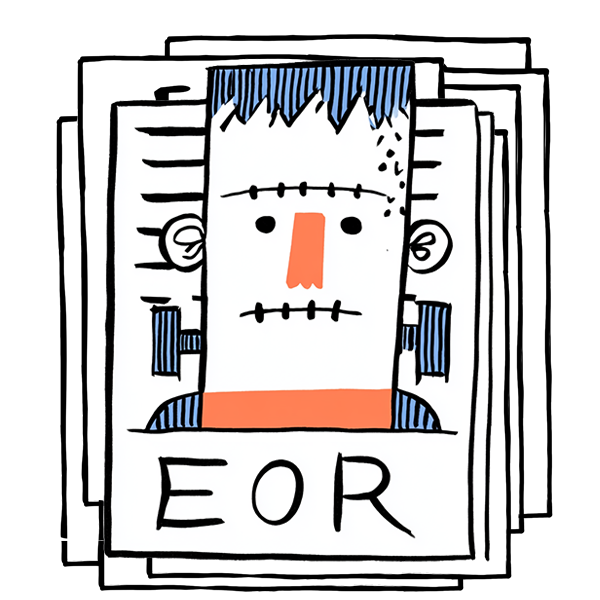
Paradigm Specialty Networks created a 96-page Frankenstein’s monster of an Explanation of Review (EOR), stitched together from hundreds of bills for multiple payers.
The practice faces hours of manual work as a result, thanks to an abomination of a payment system animated by private equity and turned loose on providers who treat injured workers. Almost as if it were purposely trying to get providers to throw their hands up and refuse to treat injured workers forever, Paradigm has built a business model that:
- Violates California law by failing to pay providers within 15 working days after receipt of a bill sent electronically (e-bill).
- Violates California regulations by failing to timely send electronic Explanations of Review (e-EORs) in response to e-bills.
- Generates massive EORs covering hundreds of bills for multiple payers and employers, forcing providers’ administrative staff to spend hours posting and reconciling individual reimbursements.
Paradigm routinely generates EORs of staggering scale. A recent example covered 395 bills for 140 different employers on behalf of the following payers:
- ESIS, Inc.
- Sedgwick Claims Management Services, Inc.
- Athens Administrators
- Marriott Claims Service Corp
- Intact Insurance Specialty Solutions
- Gallagher Bassett Services, Inc.
The payers above are legally responsible for their own compliance with state payment laws and regulations and, therefore, for the "acts and omissions" of their vendor, Paradigm.
These violations of state law and regulations represent a serious administrative drain on practice time and resources. It’s another example of why California doctors refuse to treat injured workers, California claims cost more and take longer to resolve than those in other states, and California employers face rising premiums.
Needless Manual Labor for Practice Staff
A daisyCollect practice sent nearly 400 e-bills to the payers listed above. Instead of those payers sending compliant e-EORs that would have automatically posted payment information to each bill in seconds, Paradigm dumped a single 96-page document onto its online portal covering:
- 395 e-bills
- 6 payers
- 67 rendering providers
- 140 employers
Paradigm’s EOR is non-compliant with California state laws and regulations on multiple levels.
First, California Labor Code Section 4603.4 requires payment within 15 working days of receipt of an e-bill from a provider. Of the 395 payments sent in the Paradigm Frankenstein EOR, only 88 complied with California law; 307 payments were late.
Second, California Labor Code Section 4603.3 requires claims administrators to send EORs to providers in the manner prescribed by state regulations, which requires them to respond to e-bills within 15 working days with an e-EOR. The practice submitted all 395 bills electronically, but the provider received zero valid e-EORs.
Third, the Paradigm document fails even as a paper EOR. The California Division of Workers' Compensation (CA DWC)'s Medical Billing and Payment Guide, Section 6.2, specifies that acceptable paper EOR delivery methods include first-class mail and fax. Instead, Paradigm's über-EOR is only available on the ECHO payment portal.
Paradigm EOR Punishment
A valid e-EOR (as required by CA law) posts itself; the provider's e-billing system matches the e-EOR to the bill, records the payment details, and closes the payment loop. The staff time required to “post” an e-bill is essentially zero. But instead of complying with the Labor Code, Paradigm’s Frankenstein EOR forced practice staff to:
- Manually post payment to each procedure code across all 395 bills, keying in the amount paid, contractual reductions, and adjustment reason codes line by line.
- Retrieve and upload the entire 96-page EOR document to each of the 395 bills in the practice's billing system, because there is no e-EOR to auto-post.
If there’s a single data entry mistake in reconciling Paradigm’s massive EOR, practice staff must comb through the mess to locate the error. If manually posted bill totals don’t tie out, the practice will bear the cost thanks to a blatant violation of state law and regulations.
This non-compliance represents hours of manual labor to accomplish what a compliant e-EOR does in milliseconds.
All six payers benefited from receiving e-bills from providers. However, Paradigm ignored the payer’s legal obligation to respond in kind with an e-EOR, thereby making e-billing a one-way street. The practice expended time and resources to comply with e-billing. The payers accepted the resulting gains in efficiency and rewarded the practice with a document dump.
daisyBill will file formal Audit Complaints with the CA DWC, reporting each of the six payers, which are legally responsible for Paradigm’s conduct on their behalf.
Paradigm is one vendor. The six payers listed above are among the largest names in workers' comp. The 395 bills in this single EOR represent hundreds of hours of avoidable work for a single practice. Unfortunately, for providers who treat injured workers, Paradigm routinely generates EORs like this.
Multiply this kind of inefficiency across every California practice still trying to treat injured workers, and the results are predictable: providers exit, claims drag out, and employers ultimately pay more.
daisyBill analytics help providers keep track of every cent owed for treating injured workers. Click below to learn more:
LEARN MORE: DAISYBILL

DaisyBill provides content as an insightful service to its readers and clients. It does not offer legal advice and cannot guarantee the accuracy or suitability of its content for a particular purpose.


Paradigm is one of the many contracts we have dropped. Obtaining payment was slow and arduous.