CA: Providers Aren’t the Problem. The PR-2 Is.
In a recent post republished on WorkCompCentral, defense attorney David W. Stewart bemoans “defective” PR-2 reports from California physicians treating injured workers and the burden those defects put on the attorneys representing payers.
In California, the Primary Treating Physician (PTP) must submit a PR-2 form, which outlines the injured worker’s condition, to the claims administrator at least every 45 days while the injured worker is receiving continuing medical treatment.
We agree that all parties to a claim need thorough information to ensure appropriate care and benefits; however, the real “defect” in the system is the PR-2 form itself and the paltry reimbursement paid for completing this essential form.
The providers are not the problem. The archaic PR-2, which predates modern digital medical reporting, includes over 50 fields, many of which duplicate the information providers send on the actual bill. Most Electronic Medical Records systems cannot complete this state-specific form that applies to a tiny (tiny!) percentage of medical bills.
Further, the PR-2’s 50+ fields are inadequate to support the information requested or required to get a workers’ comp bill paid. As a result, providers often must attach separate documentation to substantiate their bills, rendering the PR-2 functionally worthless.
Finally, providers at the current fee schedule rate receive only $16.14 for submitting a PR-2.
Given rampant discount contracting, providers rarely receive even that paltry amount; daisyData on billing code WC002, which providers use to bill for PR-2 reports, shows that providers receive, on average, 91% of the fee schedule rate for that code. This means providers are paid less than $15 to complete a form that Mr. Stewart insists is imperative to manage an injured worker’s care.
Instead of badgering providers for failing to complete this primitive paperwork, Mr. Stewart would do better to recognize that the form itself and the reimbursement for completing it need reforming.
You Get What You Pay For
In his blog post for Bradford & Barthel, LLP, Mr. Stewart notes that a common tactic for the defense is to object to the PR-2 report in the hopes of “triggering” a Medical-Legal dispute (emphasis ours):
“...it is generally the defendant who is exercising their available remedies, which among others, consists primarily of:
1. Promptly objecting to the report of the PTP under Labor Code Section 4062 based on the medical determination of the PTP. In most instances, we are doing this for the purposes of triggering the med-legal process to obtain a PQME in a desired specialty to evaluate the applicant, and move the claim toward an eventual Permanent and Stationary finding.”
As the saying goes, “you get what you pay for.”
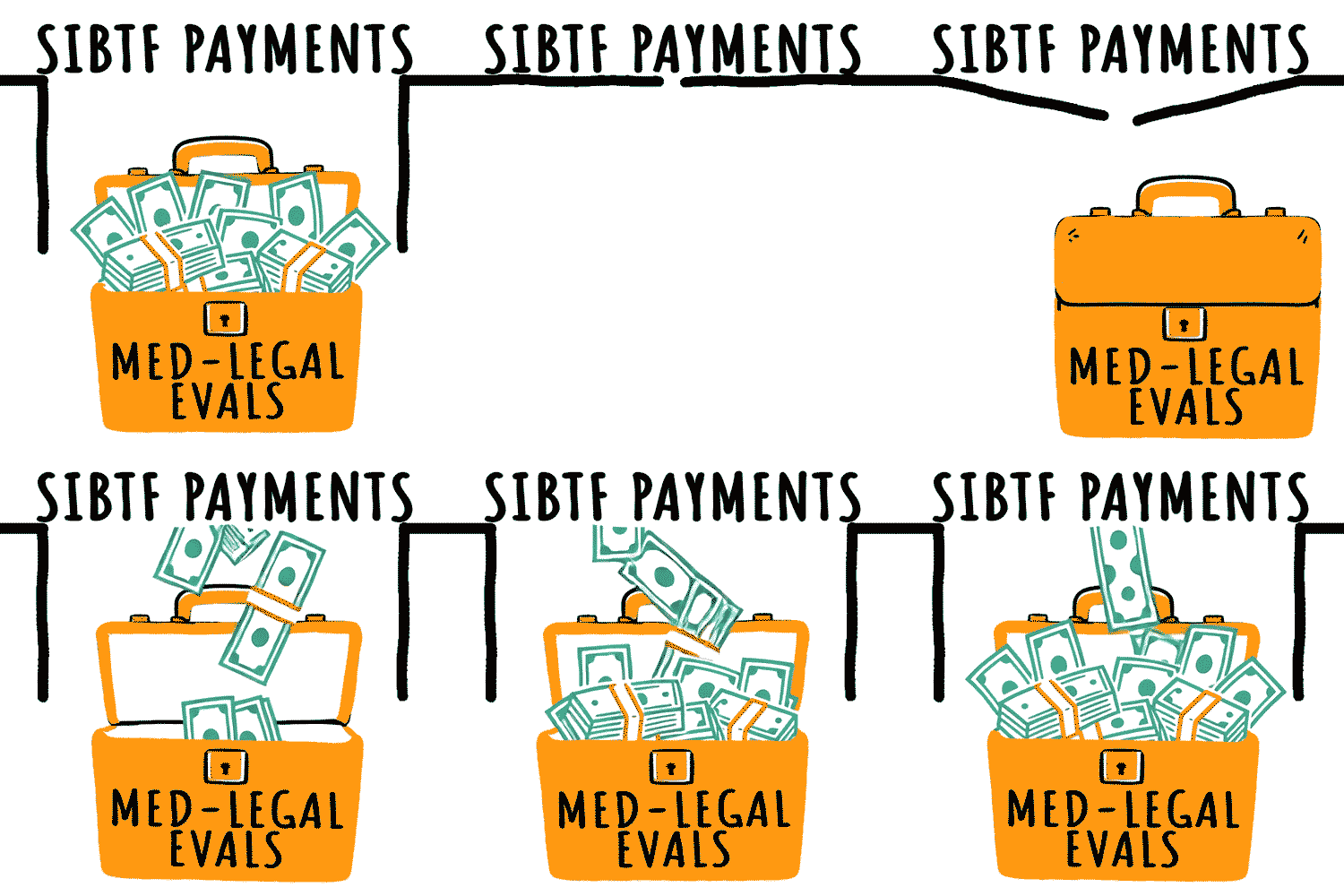
PTPs are paid less than $15 for a PR-2, whereas a Panel Qualified Medical Evaluator (PQME)’s rate for a Comprehensive Medical-Legal Evaluation is $2,015, not including record review fees. Add attorney fees, and quibbles over PR-2 reports become extremely costly. The quote above makes the situation plain: the PR-2’s shortcomings create a pretext for excessive, incredibly expensive disputes.
Litigation and Medical-Legal costs are among the primary drivers of California’s sky-high workers’ comp claim costs, of which the injured worker’s actual care and benefits represent a shockingly small percentage compared to other states.
daisyNews and Mr. Stewart agree that something needs to change. However, it is not the behavior of treating physicians belabored by the state’s anachronistic reporting requirements.
CA Comp: Stuck In the Previous Century
Onerous, insufficiently compensated administrative burdens on providers are a central feature of California workers’ comp.
All of the forms California law and regulations require providers to submit for workers’ comp patients reflect the century in which the state devised them: the 20th century, before medical record-keeping and administration were fully digitized.
The PR-2 is a glaring example.
The state hasn’t functionally updated the PR-2 in decades; the most recent revision in 2015 simply changed “ICD-9” to “ICD-10” in the Diagnoses section.
The form contains over 50 discrete data fields, yet leaves little physical space to report crucial details about the patient’s complaints, the physician’s findings, or work restrictions and modifications, which Mr. Stewart specifically cites as missing from many PR-2 reports. To fully substantiate their bills, providers attach separate clinical notes, often generated by their own records systems, most of which cannot natively generate PR-2 reports.
In other words, doctors create and attach their own reports because the PR-2 is insufficient.
Theoretically, California Code of Regulations Section 9785, which outlines reporting requirements, allows the physician to submit a narrative report in lieu of the PR-2. However, the narrative report must exactly mirror the PR-2 format, rendering this supposed remedy pointless. The physician may also (theoretically) reach an agreement with the payer for an alternative report, but that would require negotiating with each payer and maintaining custom report templates for each.
Moreover, the PTP must also incorporate the work of referred providers into their PR-2 reports, adding yet another layer of administrative work for which there is no additional compensation and no additional space on the PR-2 to support.
As a result, physicians often do what makes the most sense: attach their own notes to substantiate the treatments rendered and charges billed, and treat the PR-2 as an annoying formality.
Employers Should Demand Sanity
Paying a PTP to report injury information rather than engaging a PQME should seem rational to any employer footing the bill for these legal battles.
As daisyBill recently suggested to the state’s Commission on Health and Safety and Workers’ Compensation, California should replace the PR-2 with a new system, preferably entirely digital, whereby the provider:
- Documents and submits clinical findings from within their own records systems,
- Provides a defined list of claim-related details, including those regarding the injured worker’s work status, restrictions, and modifications, and
- Receives adequate reimbursement for this essential information.
Rather than blaming physicians for giving insufficient attention to the state’s throwback reporting requirements, stakeholders on both sides should advocate for a long-overdue update to those requirements, preferably one that relieves providers of needless, all-but-uncompensated clerical work.
daisyBill makes it easier to treat injured workers with automated bill tracking and task prompts for staff. Click below to learn more:
BILL BETTER: DAISYBILL


DaisyBill provides content as an insightful service to its readers and clients. It does not offer legal advice and cannot guarantee the accuracy or suitability of its content for a particular purpose.
.gif)