Liberty Mutual Celebrates “Payment Holidays” Instead of Reimbursing Providers
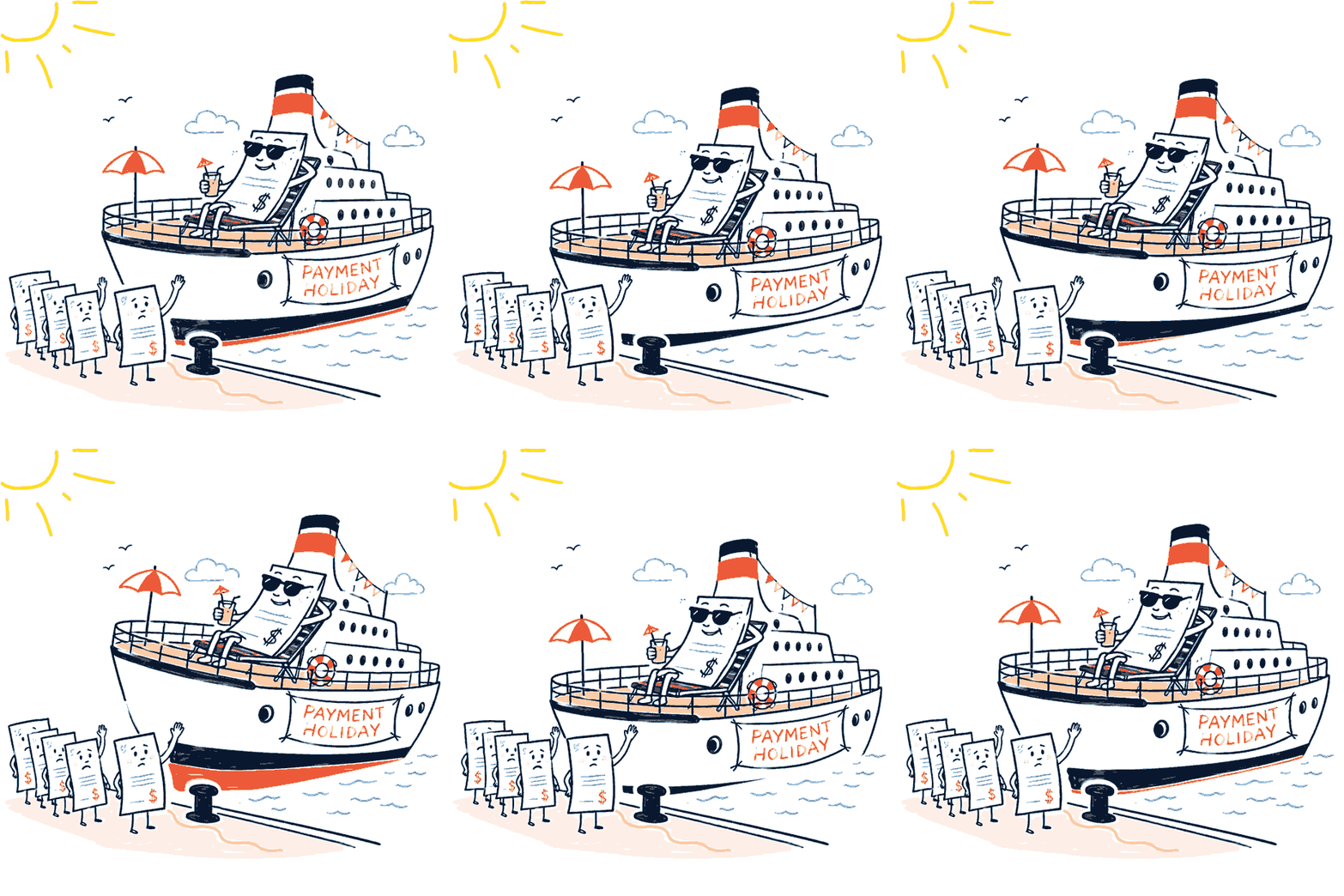
Liberty Mutual failed to pay multiple bills for an injured California worker’s treatment, only for daisyCollect to discover (again) that the insurer considered the entire claim to be on a “payment holiday,” in what may appear to be a nascent business practice of delaying reimbursement to providers.
We cannot fathom how a payer can consider itself able to declare this kind of holiday, thereby excusing itself from state law and its obligation to providers. Nothing in California law or regulations supports the idea that Liberty Mutual can invent a holiday, Festivus-style, and withhold a practice’s revenue.
Of course, Liberty Mutual needn’t worry about the consequences of these blatant violations.
The California Division of Workers’ Compensation (CA DWC) has historically done little to punish or deter non-compliance, even when it is consistent to the point of a business practice. The agency has also declared the mandatory penalties and interest payments for untimely reimbursement to be “self-executing” (i.e., effectively optional) for payers.
This time, our agents were able to reach the Liberty Mutual claim adjuster, who ultimately approved payment for the treatment of a UPS Store employee.
We do not know why or how Liberty Mutual selects claims to go on holiday, or what possible legal justification they imagine applies. We know only that if this is how effectively California protects providers, it’s very easy to see why so many choose to avoid workers’ comp patients.
Moreover, if this is how Liberty Mutual treats the providers who care for UPS Store’s injured employees, the shipping giant may want to reconsider their choice of workers’ comp insurer.
The “Payment Holiday” Strikes Again
With payment months overdue from Liberty Mutual for ten of our provider’s bills, our agents called the insurer to investigate the status of one of them.
A Liberty Mutual representative initially stated, incorrectly, that the insurer had paid the bill, but quickly corrected themselves and reported that the entire claim was “under payment holiday.” As was the case last time, the only person with the power to end one of these mysterious holidays is (apparently) the claim adjuster.
Unlike last time, the adjuster in this case was easy to reach.
In response to an email from daisyCollect, the adjuster asked for a copy of the original bill we inquired about. After daisyCollect sent a copy, the adjuster emailed another Liberty Mutual department, ordering payment and clarifying to their colleagues that the treatment in question was authorized. The adjuster cc’d daisyCollect on that email.
The adjuster also assured our agents that Liberty Mutual would pay the other nine pending bills on the same claim upon resubmission.
Liberty Mutual’s Own Set of Rules
California Labor Code Section 4603.4 and the CA DWC’s Medical Billing and Payment Guide are clear in stating that payers must accept electronic bills (e-bills) from providers and send reimbursement and an electronic Explanation of Review (e-EOR) within 15 working days.
Even if the payer denies or adjusts payment, it owes the provider an e-EOR that instantly posts the payment (or denial) details to the practice’s e-billing system, so the provider can take whatever action is necessary, whether it’s to close the bill or submit a Second Review appeal.
Nowhere in the Labor Code or Guide is there an option to place the claim “under payment holiday” and blatantly ignore an e-bill, let alone 55 of them in total (10 this time, plus the 45 from Liberty Mutual’s previous “holiday” that remain unpaid as of this writing).
Those 55 e-bills are just the ones daisyCollect is aware of for our clients; who knows how many other claims are on “holiday” statewide? Whether this is an outlier, a pattern, or a full-blown strategic business practice, it’s unacceptable.
Non-compliance in one area of state law and regulations raises fair questions about compliance in other areas. If Liberty Mutual can so easily disregard its obligations to providers, how might it treat injured workers, including those employed by UPS? We have a few horror stories in which workers bore the consequences of the insurer’s failures.
As always in California, under the fecklessness of the CA DWC and the apparent disinterest of Governor Gavin Newsom, the consequences of payer non-compliance fall only on providers, workers, and employers.
daisyBill keeps track of every bill and guides staff with automated task prompts. Click below to learn more:
LEARN MORE: DAISYBILL


DaisyBill provides content as an insightful service to its readers and clients. It does not offer legal advice and cannot guarantee the accuracy or suitability of its content for a particular purpose.
.gif)