CA DWC's UR Audits: A Keyhole View of a Statewide Crisis
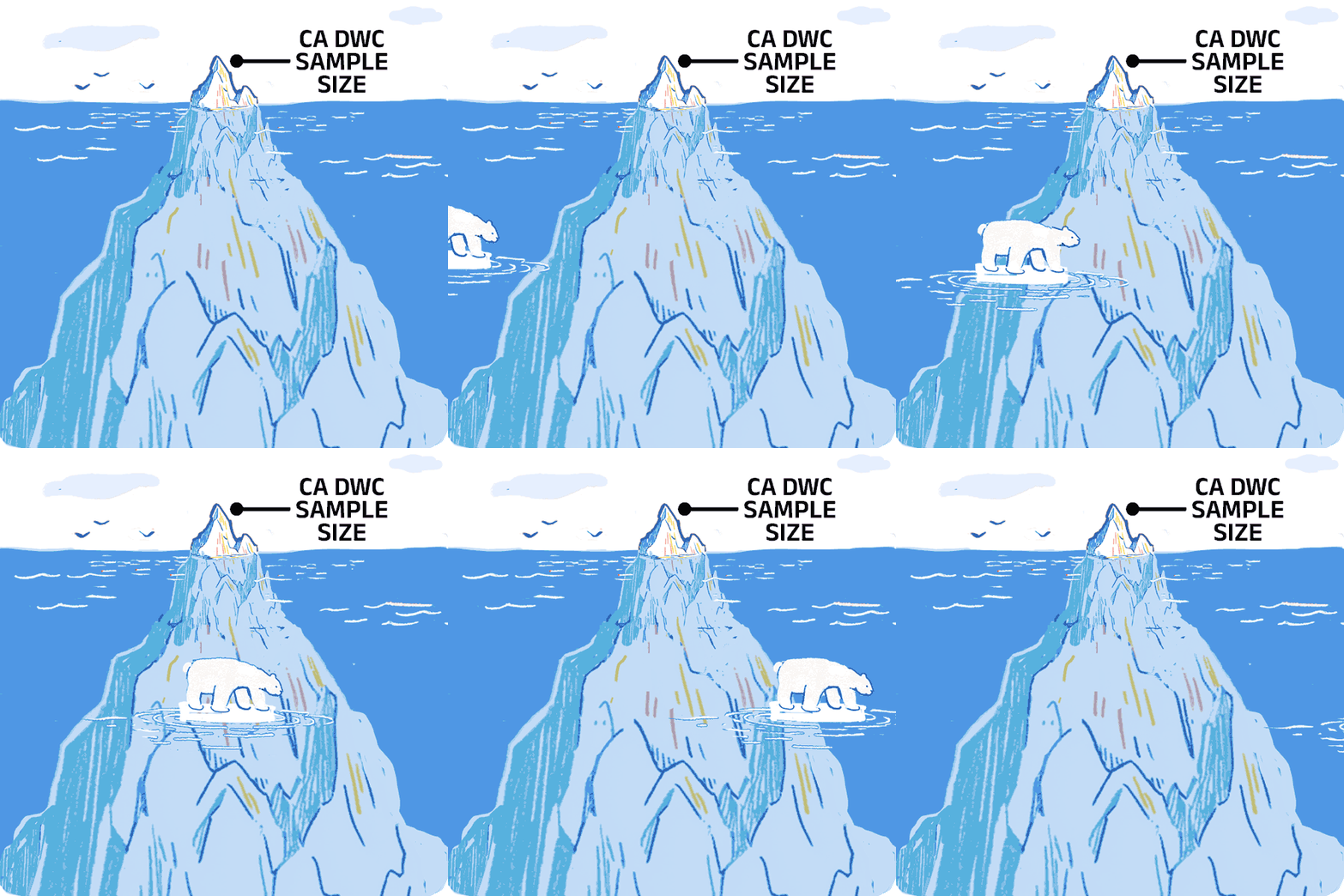
As early as 2016, California legislators recognized the potential for payers to abuse Utilization Review (UR), the process by which payers decide whether to deny or approve treatments recommended by injured workers’ physicians.
Nearly a decade later, the California Division of Workers’ Compensation (CA DWC) has demonstrated its inability or unwillingness to meaningfully confront UR abuse, leaving employers and injured workers to pay the price.
The Legislature passed Senate Bill 1160 in 2016, requiring the CA DWC to develop a mandatory electronic reporting system for all UR documents. Additionally, the Legislature passed Senate Bill 537 in 2019, requiring the CA DWC to publicize UR denial rates.
Unmistakably, California legislators are demanding that the CA DWC provide comprehensive UR data to monitor whether injured workers are receiving the treatment that they require.
The CA DWC has ignored these UR data mandates by failing to comply with the letter or intent of the law. Instead, the CA DWC conducts laughably small-scale UR “audits” of randomly selected Requests for Authorization (RFAs) that provide no meaningful insight.
- The CA DWC’s most recent audits analyzed 1,772 RFAs statewide, reflecting calendar years 2024 and 2025.
- In 2024 and 2025, 573 providers used daisyAuth to send 429,015 RFAs to payers across the state.
To use the example of just a single payer, take Sedgwick Claims Management Services, Inc., the largest workers’ comp Third-Party Administrator (TPA) in the nation:
- The CA DWC’s audits analyzed Sedgwick UR decisions for just 249 RFAs in 2024 and 2025.
- In 2024 and 2025, daisyBill clients submitted 95,346 RFAs to Sedgwick.
For two years of RFAs, the CA DWC has failed to review barely a single drop in the statewide UR bucket.
California employers pour millions into increasing workers' comp premiums, trusting that their injured employees will receive timely, appropriate care. Injured workers, already navigating pain, lost wages, and an uncertain recovery, trust that recommended treatments won't be improperly denied. Both groups deserve to know whether that trust is warranted.
Unfortunately, the CA DWC has given them no way to find out.
CA Legislators Attempt to Bring Transparency to UR
California enacted multiple laws to grant employers visibility into the UR system, so they could determine whether care is being improperly delayed or denied for their injured employees:
- Labor Code Section 4610 requires the CA DWC to establish a mandatory electronic reporting system for all UR documentation.
- Labor Code Section 138.8 requires the CA DWC to publish UR modification and denial rates.
The CA DWC has not complied with either of the above statutory requirements. There is no electronic reporting system or public UR data.
Had the CA DWC followed those laws, we would have a repository of data on every UR decision payers issued across the state, going back several years. Stakeholders could use that data to address the concerns legislators voiced in 2016 when they noted that “certain employers or UR entities” may be needlessly delaying or denying care (emphases ours):
“Recently, UR has become a growing area of concern. Both injured workers and medical providers report delays and denials of medical care due to the UR process. While such delays and denials may not be system-wide, they may be specific to certain employers or UR entities.”
Fast forward almost a decade, and stakeholders have none of the mandated UR data to assess the extent of potentially improper “delays and denials” of care. Instead, we have CA DWC audits based on paltry scraps of UR data.
CA DWC “Audits” UR Through a Keyhole
In 2024 and 2025, just 573 California providers used daisyAuth to submit 429,015 RFAs to claims administrators statewide. Compare that to the entire scope of the CA DWC’s recent audits, which, in the same time frame, analyzed just 1,772 RFAs.
daisyBill has data on over 95,000 RFAs that providers submitted to Sedgwick in 2024 and 2025, whereas the CA DWC examined fewer than 250.
daisyBill is a software company, not a state regulatory body. Yet, our data (which the CA DWC is welcome to study in anonymized form) offer exponentially more insight into UR than the agency responsible for governing UR.
Why does the CA DWC ignore the mandates of the legislature and confine its study of UR to these tiny, statistically meaningless audits?
The Legislature recognized this risk of UR abuse nearly a decade ago and demanded transparency. The CA DWC has delivered none. Until the agency complies with the law and provides real UR data, employers will keep paying more for a system they can't evaluate, and injured workers will continue to bear the consequences of a process that nobody is monitoring.
daisyAuth simplifies and streamlines the RFA process with UR decisions in 5 days on average. Click below to learn more:
LEARN MORE: DAISYAUTH

.png)
DaisyBill provides content as an insightful service to its readers and clients. It does not offer legal advice and cannot guarantee the accuracy or suitability of its content for a particular purpose.
.gif)

LC Section 138.8(a): "On or before January 1, 2024, and annually thereafter, the administrative director SHALL publish on the division’s internet website provider utilization data."
While this section requires action, it contains NO penalties for the Administrative Director's failure to comply.
LC Section 4610 (p): "If the administrative director determines that the employer, insurer, or other entity subject to this section has failed to meet any of the timeframes in this section, or has failed to meet any other requirement of this section, the administrative director MAY assess, by order, administrative penalties for each failure. A proceeding for the issuance of an order assessing administrative penalties shall be subject to appropriate notice to, and an opportunity for a hearing with regard to, the person affected. The administrative penalties shall not be deemed to be an exclusive remedy for the administrative director."
This section has zero power. The Administrative Director MAY or MAY NOT, at his/her own discretion, apparently, order penalties against carriers or TPAs.
Now that we have NO Administrative Director at all, I guess we can expect business as usual. Maybe a former Sedgwick executive would like the job. It pays reasonably well, $16,015.73 per month ($192,188 annually), before "perks."