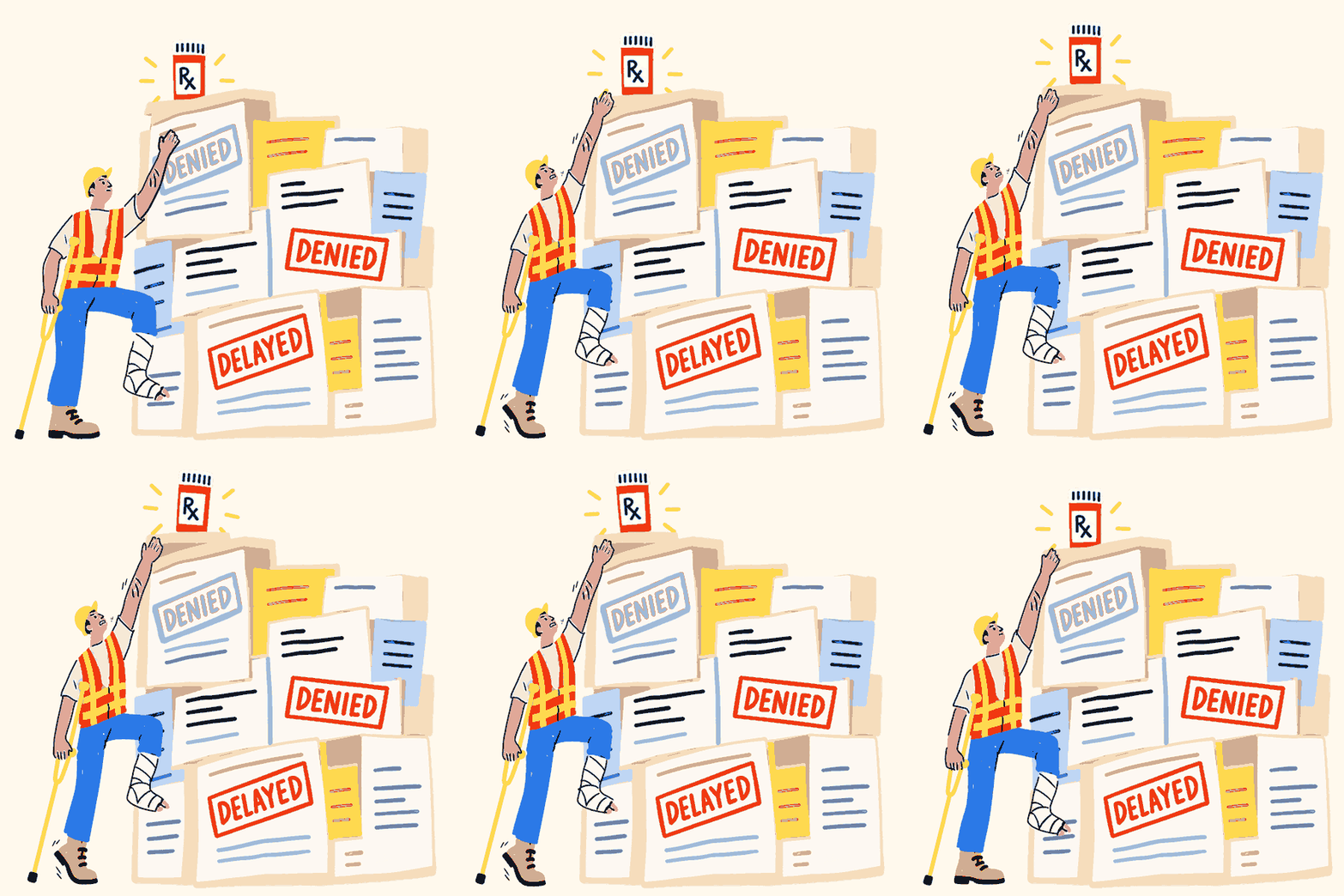
Tesla Insurer Zurich Sends "Certification" Providers Can’t Trust

Treatment authorization should be a fairly straightforward process, even in the convoluted world of California workers' comp: the doctor submits a compliant request for treatment, and the payer responds by authorizing, modifying, or denying the treatment. Under California law, authorization is the provider’s guarantee of reimbursement for approved treatment.
Apparently, that's too straightforward for Zurich Insurance North America.
A California provider requested a neurologist referral for a Tesla injured worker for a 2023 injury. In response, Zurich (Tesla's workers' comp insurer) sent a document it calls a "Certification Notice" that acknowledges the requested treatment as medically necessary and appropriate, but explicitly disclaims any obligation to pay for it.
The Zurich document instructs that only a claims adjuster can guarantee payment. This means that the provider, having already received Zurich's acknowledgment that the treatment is appropriate, would have to call a claims adjuster to obtain a separate payment guarantee.
When the neurologist rendered the approved treatment, Zurich denied reimbursement, citing that it was not liable for the 2023 injury. Zurich also denied payment for the subsequent Second Review appeal. To pursue reimbursement, the neurologist must now pay $195 to request Independent Bill Review (IBR).
Tesla and all California employers should pay attention.
When doctors cannot rely on payment for even approved care, treating injured workers is a financial risk. The predictable, rational response is to stop accepting workers' comp patients altogether. The net result is fewer doctors willing to treat injured workers, longer delays to care, and worse health outcomes.
If employers want to understand why doctors are walking away from comp, this is a perfect example.
Zurich’s Non-Authorization
California Code of Regulations Section 9792.6.1(a) defines "Authorization" as "assurance that appropriate reimbursement will be made" for approved treatment. Yet, Zurich's response to the provider's request for treatment was a "Certification Notice" bearing the following disclaimer (emphases ours):
"CERTIFICATION OF THE TREATMENT REFERENCED BELOW IS NOT AN APPROVAL OF BENEFITS. ONLY A CLAIM ADJUSTER MAY MAKE GUARANTEE OF PAYMENT. ALL TREATMENT IS SUBJECT TO THE POLICY PROVISIONS AS WELL AS STATE REGULATIONS REGARDING ELIGIBILITY AND COMPENSABILITY."
Zurich explicitly states that its certification does not guarantee payment. But under CCR § 9792.6.1(a), authorization is by definition an assurance of reimbursement, with no separate payment guarantee required from a claims adjuster.
By disclaiming any payment obligation, Zurich is effectively declaring that this document is not an authorization under California law.
Which raises an obvious question: what exactly is it, then? And what use is it to a provider?
A Document That Eliminates Financial Obligation
Under California's Utilization Review (UR) regulations, revamped effective April 1, 2026, a payer's response to a compliant request for treatment must be one of exactly three things:
- An approval of the requested treatment
- A modification of the requested treatment
- A denial of the requested treatment
There are no other options. Yet, Zurich's "Certification Notice" is none of the above. It neither approves, modifies, nor denies the requested treatment. In other words, it is not a lawful response to a lawful treatment request.
This is the trap. At a glance, the document looks like permission to treat. Any reasonable provider would interpret an insurer acknowledging that care is necessary and appropriate as a green light to proceed. But the disclaimer instructs otherwise.
Consider what that means in practice. Zurich has already reviewed the request and acknowledged the treatment as medically necessary. But the provider must track down a claims adjuster to obtain a separate payment guarantee that California regulations say the certification itself should already provide.
How does that adjuster document a payment guarantee? An email? A phone call? Would either hold up if Zurich later denied payment?
Providers are left with two choices:
- Contact the adjuster, navigate the informal process, and hope the adjuster's response, whatever form it takes, holds up if payment is later denied, or
- Withhold care from an injured worker whose treatment Zurich itself acknowledges is medically necessary.
Neither option is acceptable.
The Trap Closes
Taking the certification as an approval to treat, the neurologist rendered the care in question.
The provider included the Zurich Certification document with their bill for the treatment. Zurich denied reimbursement, stating that the 2023 injury was "not a work-related injury/illness and thus not the liability of the workers' compensation carrier" (see the Explanation of Review below). The neurologist submitted a Second Review appeal to dispute the payment denial, which Zurich also denied.
That leaves the neurologist with one remaining option: pay $195 to file for IBR to seek payment for care that Zurich acknowledged as appropriate.
What this means for Tesla
Zurich is Tesla's workers' comp insurer. Tesla pays premiums so that Zurich will administer its claims obligations, including ensuring that providers receive payment for authorized treatment. That’s the basic promise of the employer/comp insurer relationship. Tesla should demand at least that much from Zurich.
If this is how Zurich treats the physicians caring for Tesla's injured workers, the question worth asking is: how is Zurich treating Tesla’s injured workers?
There’s a practical consequence worth considering. Tesla operates in California and employs a significant workforce. When providers cannot rely on Zurich's certifications as guarantees of payment, treating Tesla's injured workers becomes a financial liability for practices. The provider network narrows, care is inevitably delayed, and outcomes worsen.
Tesla's premiums fund a system that should protect its injured workers. Zurich's certification document undermines this premise.
The Regulatory Gap
California law requires providers to submit treatment requests on a standardized Request for Authorization (RFA) form, with strict requirements for content and medical documents.
Payers face no comparable regulatory requirement mandating how they respond to a compliant RFA. They can issue responses in any form or format of their choosing, including, as daisyNews has reported, documents that are bloated, illegible, or do not adequately address the treatment request. In this case, Zurich sent something that may appear to be an authorization while disclaiming its legal effect.
The California Division of Workers’ Compensation (CA DWC) has done nothing to address this asymmetry. Despite issuing new UR regulations in April 2026, the CA DWC refuses to require payers to respond to RFAs in a clear, standardized format.
Providers treating Tesla’s injured workers, be warned: when Zurich sends you something that looks like authorization, read closely. If it says "ONLY A CLAIM ADJUSTER MAY MAKE GUARANTEE OF PAYMENT," you have not received authorization under California law. Be prepared for a reimbursement battle.
Submit compliant RFAs in seconds with daisyAuth. Click below to see how it works:
LEARN MORE: DAISYAUTH




DaisyBill provides content as an insightful service to its readers and clients. It does not offer legal advice and cannot guarantee the accuracy or suitability of its content for a particular purpose.
.gif)