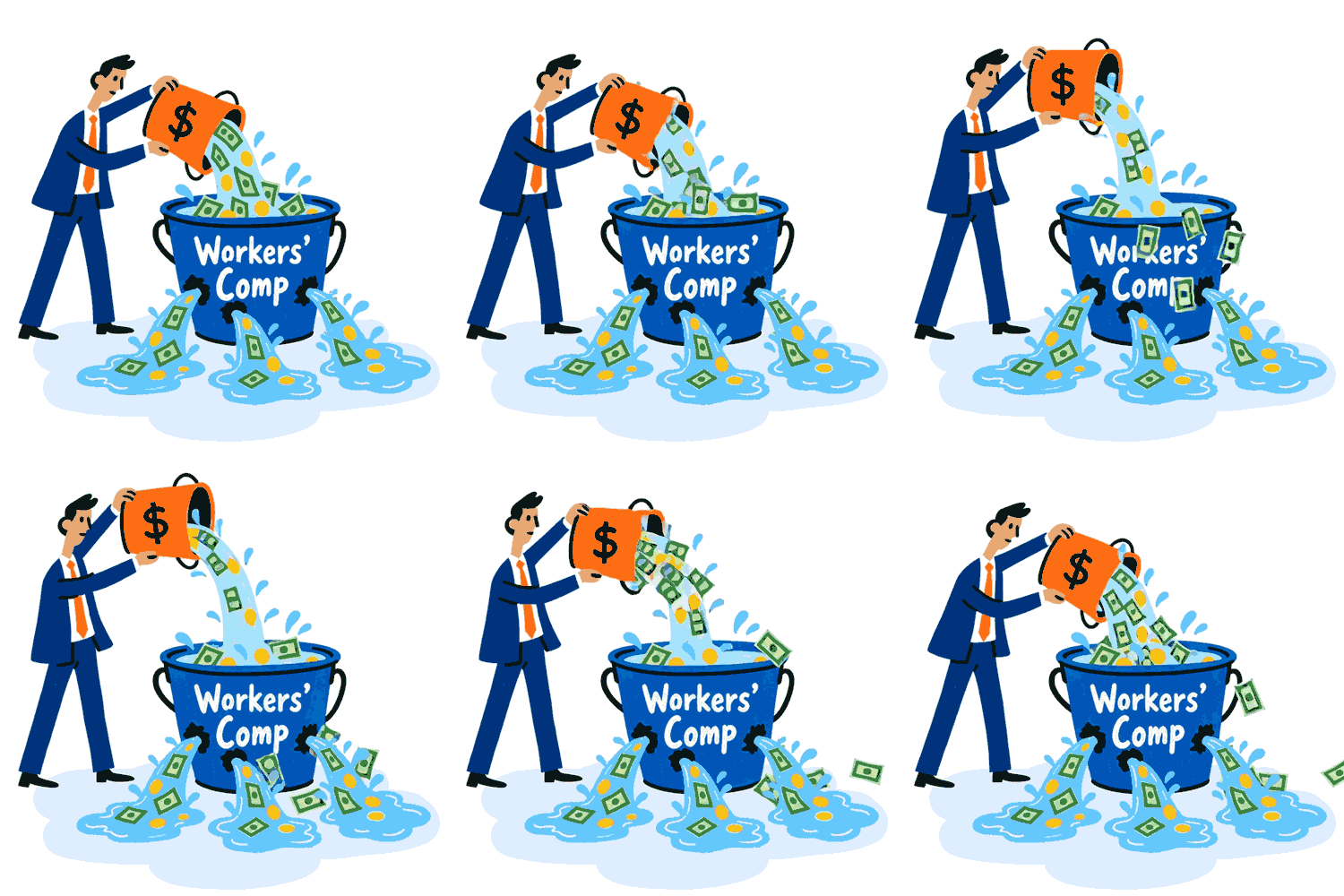
Data: PPOs Are Another “Cost Control” Measure That Hurts CA Employers

California employers pay more than almost any other state for comp coverage, with premiums set to rise again in September. California claims take twice as long and cost twice as much to resolve as the national medians, strongly indicating that insurers and Third-Party Administrators (TPAs) are not spending employers’ premium dollars efficiently.
So, why are employers’ investments into workers’ comp premiums producing such a poor return? A huge part of the answer is Preferred Provider Organizations (PPOs).
We’ve discussed how the Utilization Review (UR) and Medical Provider Network (MPN) systems contribute to the broader systemic failure. But no discussion of California workers’ comp dysfunction is complete without a hard look at PPOs.
PPOs are the single largest factor driving down (already low) provider reimbursement and making it financially untenable for practices to accept workers’ comp patients. The facts are simple, and the obvious conclusion is inescapable:
- Treating injured workers in California is prohibitively administratively expensive for providers.
- California’s physician fee schedule for workers’ comp is one of the lowest nationally, paying only 155% of Medicare rates in 2026 (up from 151% of Medicare in 2025).
- PPO discounts significantly reduce reimbursement under California’s already-low fee schedule rates.
- MPNs make providers’ eligibility to treat injured workers conditional on joining PPOs.
Below, see hard daisyData on the net impact PPOs have on provider reimbursement. Inevitably, many practices conclude that they can’t afford to accept workers’ comp patients under the reimbursement tyranny of the MPN/PPO “pay-to-play” system.
As a result, injured workers can lose access to care…and stay injured longer.
Those extended claim durations mean more doctor visits, administrative services, and legal battles. While PPO discounting may appear at a glance to lower claim costs by decreasing reimbursement, the net effect of a system that deters provider participation is bound to be worse health outcomes.
For employers, that translates to lost productivity (as injured employees remain out of work and other employees must shoulder the additional load), and, ultimately, higher workers’ comp premiums.
Clearly, PPOs are failing to control costs for employers, as California’s increasing premiums defy a nationwide trend of decreasing premiums.
CA Pays Providers Peanuts (and That’s Before PPOs Get Involved)
According to a 2025 report from the Workers’ Compensation Research Institute (WCRI), California’s fee schedule rates for professional services are among the lowest nationally.
As the graph below from the report shows, at the time of the report, California’s Physician Fee Schedule paid 51% more than the Medicare rates (as of March 1, 2026, this has increased to 55%). Compare this to the 16 states that pay 100% or more than Medicare, including Nevada, which pays 200% more than Medicare.
Moreover, the WCRI concludes that California fee schedule rates are even lower in effective terms, when one considers the extraordinary practice expenses of delivering care in California (emphases ours):
“...if we were to compare workers' compensation fee schedule aggregate rates before adjusting for the interstate differences in expenses, we would conclude that reimbursement rates in California were 9 percent below the median state. However, after adjusting for the fact that expenses for delivering medical care were higher in California than in most other states, the aggregate fee schedule rate was 17 percent below the median state.”
…all of that is before PPOs get their collective hands on provider reimbursement.
daisyData: CA Providers Get 83% Fee Schedule Rates on Average
Once PPOs enter the scene, the California workers’ comp fee schedule rates go from insufficient to nearly irrelevant.
Under threat of exclusion from MPNs, providers sign PPO discount contracts. Before the ink is dry on these contracts, the contracting entity leases, sells, and otherwise shares the contractual discount with other entities, including payers, bill review services, and more. Sophisticated vendors identify and “stack” PPO discounts to gut provider reimbursement, dropping practice revenue across the board.
The net effect of PPO discounting on the whole system is profound.
daisyBill tracks reimbursement data for our thousands of California provider clients; those data reveal that collectively, the providers in our system receive 83% of the already-low state fee schedule rates.
This can drive providers to tap out of workers’ comp, unable to financially justify the pittance PPOs pay them for treating injured workers. With fewer providers willing to treat them, access to care can suffer. Injuries worsen, disability costs increase, and insurer-funded rating bureaus demand higher premiums from employers.
Below, we list the 25 largest payers in daisyBill’s systems, measured by the volume of bills daisyBill clients submitted to those payers for 2025 dates of service (during most of which, California’s physician fee schedule theoretically paid 151% of Medicare rates). For each, we list:
- The amount due under the California Physician Fee Schedule (excluding facility and pharmacy services) for dates of service from January 1, 2025, through December 31, 2025
- The percentage of the California Physician Fee Schedule rates that providers actually received
- The percentage of the Medicare rates providers received
- The total number of bills submitted by daisyBill providers
- The number of rendering providers
These data show, in stark terms, how PPOs have undermined the financial viability of treating injured workers. The status quo is working splendidly for PPOs and their private equity backers; not so much for employers dumping premium dollars into a defective system.
Claims Administrator |
CA Fee Schedule Amount Due |
% of CA Fee Schedule Paid |
% of Medicare Rate Paid |
Bill Count |
Rendering Provider Count |
Sedgwick Claims Management Services, Inc. |
$64,940,459 |
83% |
126% |
247,109 |
1,530 |
State Compensation Insurance Fund (CA) |
$26,712,802 |
85% |
128% |
109,261 |
1,252 |
Intercare Holdings Insurance Services, Inc. |
$19,598,534 |
83% |
128% |
80,053 |
1,071 |
CorVel |
$15,762,173 |
82% |
124% |
65,919 |
1,261 |
Gallagher Bassett Services Inc. |
$15,763,501 |
82% |
122% |
62,556 |
1,053 |
Liberty Mutual Insurance |
$12,546,045 |
85% |
126% |
50,388 |
1,013 |
Athens Administrators |
$12,659,839 |
82% |
122% |
51,014 |
1,175 |
Keenan & Associates |
$8,451,186 |
83% |
124% |
35,410 |
816 |
Zurich Insurance North America |
$8,000,994 |
82% |
122% |
34,010 |
1,000 |
Travelers |
$6,762,588 |
84% |
125% |
27,311 |
987 |
AmTrust North America, Inc. |
$6,554,526 |
79% |
117% |
24,764 |
774 |
Cannon Cochran Management Services, Inc. |
$5,693,123 |
85% |
126% |
21,888 |
863 |
Berkshire Hathaway Homestate Companies |
$5,671,352 |
79% |
124% |
22,626 |
747 |
Broadspire Services, Inc. |
$5,044,600 |
83% |
122% |
18,589 |
810 |
The Hartford |
$5,019,080 |
79% |
116% |
19,472 |
901 |
Insurance Company of the West |
$4,769,189 |
80% |
119% |
18,569 |
701 |
LWP Claims Solutions, Inc. |
$3,966,574 |
84% |
125% |
16,305 |
792 |
Helmsman Management Services LLC |
$3,850,704 |
84% |
125% |
14,903 |
661 |
ESIS, Inc. |
$3,494,778 |
86% |
129% |
12,201 |
574 |
Los Angeles County Metropolitan Transit Authority (CA) |
$3,411,859 |
77% |
120% |
10,795 |
240 |
Tristar Risk Management |
$2,984,536 |
85% |
132% |
11,754 |
608 |
CopperPoint Mutual |
$2,704,366 |
80% |
120% |
11,444 |
693 |
The Zenith |
$2,637,968 |
81% |
121% |
11,885 |
452 |
Next Level Administrators |
$2,152,730 |
77% |
113% |
8,824 |
559 |
Employers Compensation Insurance Company |
$840,220 |
79% |
118% |
3,275 |
356 |
Totals |
$249,993,727 |
83% |
125% |
990,316 |
1,918 |
daisyBill gets providers paid faster and more accurately for workers’ comp treatment. Click below to learn more:
BILL BETTER: DAISYBILL




DaisyBill provides content as an insightful service to its readers and clients. It does not offer legal advice and cannot guarantee the accuracy or suitability of its content for a particular purpose.
.png)