NY Applicant Attorney: Payer Delays Are Hurting Workers
.gif)
Applicant attorney Nicole Brenecki of Jodré Brenecki, LLP believes there’s a gaping flaw in New York’s workers’ compensation system, one that’s actively harming the health of injured workers: payer delay tactics.
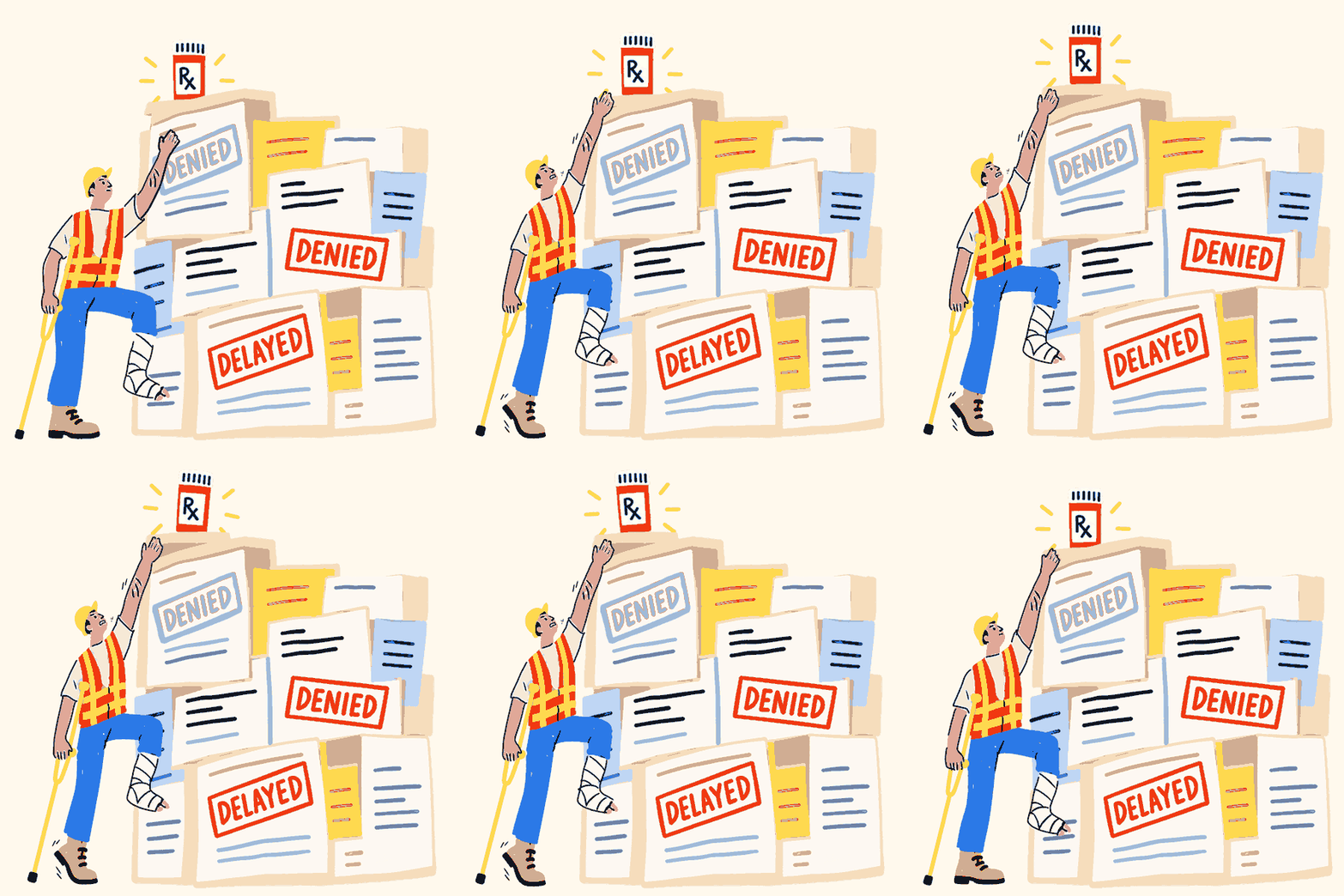
In a scathing op-ed, Brenecki, who represents injured workers, decries New York’s “broken” comp system for allowing administrative tussling to leave injured workers without appropriate medical care or benefits, with insurer appeals dragging the claims process out for months or years.
In Brenecki’s estimation, these delays are effectively no different from outright denials of care and benefits, at least during the excessively long periods in which the injured worker battles the payer.
While noting recent achievements by the state’s Workers’ Compensation Board (WCB) in scheduling injured workers’ hearings, Brenecki maintains that “A hearing scheduled quickly is not necessarily a dispute resolved quickly.”
Based on the experience of at least one of her injured worker clients, a crackdown on potential payer stalling may be warranted.
Delay or Denial? For an Injured Worker, It’s Semantics
As far too many injured workers in California have experienced, payer delays can worsen injuries and lengthen disability times.
Unlike with California’s abysmal Utilization Review process, New York does not require providers to seek approval for most treatments that adhere to the state’s Medical Treatment Guidelines (MTGs). Per New York Codes, Rules, and Regulations Section 325-1.25, the payer must reimburse for properly documented, MTG-supported care.
However, in certain cases, payers can challenge the necessity or appropriateness of some treatments or other comp benefits.
This can result in a standoff between the payer and the injured worker, one that can take months of hearings, appeals, and other bureaucratic wrangling to resolve, during which the injured worker must continue living their life, pay their bills, and grapple with their (potentially untreated) condition.
These delays can be extreme; Brenecki cites one of her clients’ two-and-a-half-year ordeal, with the insurer “controverting” every aspect of the claim. The result was the appalling timeline below:
- Jan 2024: The worker was injured and filed their claim
- May 2024: First WCB hearing
- November 2024: Second WCB hearing
- January 2025: Evidentiary hearing
- March 2025: Final testimony
- August 2025: Workers’ Compensation Law Judge rules in workers’ favor, and carrier appeals.
- August 2026: Appellate board rules in workers’ favor
After a year and a half of payer resistance, the state determined that the worker was entitled to the benefits in question, only for the worker to endure an additional year fighting the payer’s appeal.
Reportedly, when the insurer finally paid following the appellate Board’s order, it underpaid significantly, meaning the saga continues as of this writing. Note that the WCB labeled its initial decision in mid-2024 as “expedited.”
For an injured worker in a position like this, the difference between delay and denial can be a matter of semantics. Or, as Brenecki puts it (emphasis ours):
“At some point, delay ceases to be an administrative inconvenience and becomes the functional equivalent of denial.”
Building on NY Progress
Brenecki acknowledges recent efficiency improvements at the WCB, with the Board in 2025 touting 50% faster scheduling for hearings, which now takes an average of 35-37 days following the hearing request.
daisyNews has also lauded the sustained and largely successful push for enhanced efficiency, including:
- Moving all Prior Authorization Requests for injured worker treatment to an online digital format
- Mandating electronic billing and automatic data collection
- Allowing resident and fellow physicians to treat injured workers
We predict that ultimately, the data will show that the above measures made it easier and faster for injured workers to get what they need.
That acknowledged, payers will always have opportunities to procedurally roadblock the process of obtaining care and/or benefits. If the data currently flowing into the WCB confirms Brenecki’s suspicions, more stringent measures to identify and deter payer foot-dragging may be in order.
Don’t settle for a simple clearinghouse. daisyBill is a WCB-approved e-billing partner. Click below to learn more:
BILL BETTER: DAISYBILL


DaisyBill provides content as an insightful service to its readers and clients. It does not offer legal advice and cannot guarantee the accuracy or suitability of its content for a particular purpose.
.gif)