Warning: ECHO Deducts "Service Fee" From Paradigm Payment
This article has been corrected. See note at the end.
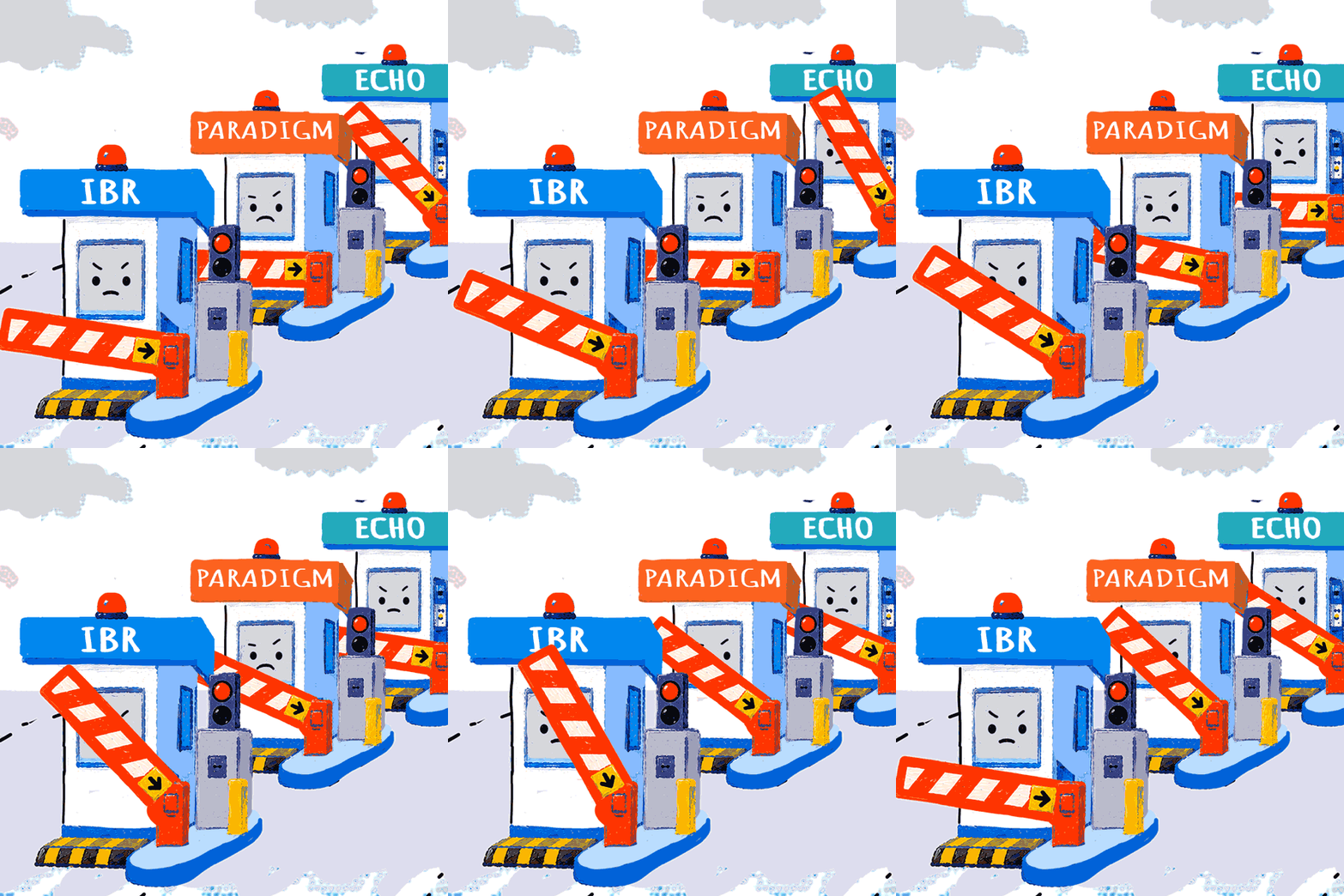
As daisyNews explored in recent articles, Paradigm Specialty Networks profits by intercepting providers' reimbursements for injured workers' treatment, imposing reductions, and issuing the remainder to the provider. Apparently, Paradigm is teaming up with another intermediary, payment processing vendor ECHO Health, to impose yet another "toll" in the form of exorbitant processing fees.
After lopping nearly $800 off a California orthopedic surgeon's reimbursement from insurer Zurich North America (paying just 66% of the amount allowed for a knee surgery under the state fee schedule), Paradigm issued an Explanation of Payment (EOP) that indicated an additional 1.99% "ECHO Service Fee."
This ECHO fee is the third financial hit inflicted on this surgeon’s reimbursement for treating an injured worker.
As previously reported, the surgeon had to pay a $195 filing fee to request Independent Bill Review (IBR) to force Zurich to pay at all. Paradigm slashed $786.02 from Zurich’s payment, and ECHO nabbed a $31.68 service charge.
daisyBill investigated and found that the ECHO Service Fee is apparently the price providers must pay for ECHO's "All-Payer EFT [Electronic Funds Transfer]" payment plan. Crucially, the only fee-free alternative, "Direct Payer EFT," requires significant paperwork and seems to serve no purpose other than pressuring providers to accept the 1.99% All-Payer EFT fee on every reimbursement.
Ultimately, this surgeon had to submit the bill three times and wait months for payment (instead of the 15 working days mandated by California law), all to receive just 66% of the amount allowed by the state fee schedule for an authorized procedure, equivalent to only 96% of the Medicare rate (as opposed to the 146% of Medicare rates allowed by the fee schedule for that date of service).
The Zurich/Paradigm payment also did not include the “self-executing" penalties and interest California law requires for a reimbursement that was due on March 26, 2026, but didn’t limp through the door, considerably reduced, until May 18.
In California, employers pay increasing premium rates to ensure their employees' care, only for third, fourth, and fifth-party middleperson entities to feed on the revenue stream, leaving doctors with unsustainable rates for treating injured workers. This system works out great for private equity, not so much for the employers footing the bill and the injured workers struggling to access care.
ECHO Adds to Paradigm's Toll
Paradigm's EOP (below), in addition to reflecting Paradigm's $786.02* "Contract Reduction," shows a $31.68 ECHO Service Fee, which equals 1.99% of the total payment amount.
When daisyBill reached out to Paradigm, their representative seemed genuinely flummoxed by our question, repeatedly stating that we were the first to inquire about the ECHO fee.
A Paradigm representative confirmed that the fee had nothing to do with Paradigm's role as a network payer; ECHO's fee is a separate imposition that, as the Paradigm representative explained, is (emphasis ours):
"...deducted or applied due to payment method or vendor, not clinical service or claim charge. So, we didn't charge you anything, that's just strictly ECHO, and we don't have any control over that."
The Third “Toll" on a Single Bill
For the surgeon in this case, the ECHO fee is more than just an isolated annoyance. It’s the third needless expense the practice absorbed in pursuit of reimbursement:
- $786.02: Paradigm's "Contract Reduction," bringing reimbursement to just 66% of the California fee schedule rate (and below the Medicare rate).
- $195.00: The IBR filing fee the surgeon had to pay out of pocket simply to force Zurich and Paradigm to pay for an authorized procedure. Thanks to a pattern of state non-enforcement, there’s a depressingly high chance Zurich will not refund the provider for this fee.
- $31.68: ECHO's 1.99% "Service Fee," deducted from what remained after Paradigm's reduction.
The employer paid Zurich to pay for the care of its injured employee. Paradigm and ECHO, neither of which provided any treatment or arguably any real value to the employee, simply positioned themselves to extract profits from the funds meant to reimburse the provider who performed the surgery.
ECHO's EFT Extraction: Manufactured Administrative Torture
Payment processing vendors like ECHO purport to deliver payments more quickly and securely than other methods, such as paper checks. This claim is questionable at best, since:
- States establish legal deadlines by which payers must remit reimbursement
- Providers who bill electronically receive payment quickly in every form (daisyBill providers receive payment in 9.6 days on average)
In addition to withholding legally required Explanations of Review (EORs) from providers as part of its aggressive marketing efforts, ECHO apparently also charges providers to avoid some of the paperwork involved in opting into EFT payments.
Most importantly, the paperwork requirements that ECHO uses to push providers into All-Payer EFT are not inherent to electronic payment processing. They are a burden ECHO created, avoidable only by accepting a nearly 2% loss on every payment, forever.
daisyBill reached out to ECHO after our conversation with Paradigm. ECHO confirmed it offers a pointlessly burdensome payment option for free, and a streamlined option for a fee as follows:
All-Payer EFT:
- Providers complete a single form to opt in to receive EFT payments, which applies to all of ECHO's payer clients.
- Enrollment takes 3 business days.
- The provider pays a 1.99% "Service Fee" for every payment received.
Direct Payer EFT:
- The provider completes a separate form for each of ECHO's payer clients to receive EFT payments.
- Enrollment takes 7-10 business days.
- There is no fee for receiving EFT payments.
In the follow-up message below, which ECHO sent to daisyBill, ECHO implied that it will impose slower reimbursement and extra paperwork on any provider who refuses to opt in to All-Payer EFT. ECHO dubiously promises "expedited payments" with All-Payer EFT, and contrasts All-Payer EFT's "single-source enrollment" against Direct-Payer EFT's form requirements.
How to Opt Out of All-Payer EFT
daisyBill confirmed with ECHO how providers can "disenroll" from All-Payer EFT if they choose not to capitulate and sacrifice nearly 2% of their revenue. Providers must send an email request to allpayer@echohealthinc.com that includes:
- The provider's Tax Identification Number
- A statement that, according to the ECHO representative, the provider is "not OK with the fee."
- A clear request to disenroll from All-Payer EFT
To enroll in Direct Payer EFT, with no fees, the provider must complete this form and submit it to ECHO per the instructions found here.
CA Employers: Is This What You're Paying For?
Paradigm, ECHO, and (in this case) the IBR request all represent the same core problem in workers' comp: needless friction that adds layers of administrative expense to the benefit of third, fourth, and fifth-party middleperson entities.
The surgeon performed an authorized procedure, navigated months of obstruction, paid $195 to force payment, and ultimately received less than the Medicare rate, with an additional 2% skimmed off at the end.
Entities like Paradigm and ECHO offer arguably little to no value, simply standing in the path of reimbursement with their hands out. As a result, providers find it increasingly difficult to financially justify treating injured workers.
The resulting scarcity of care delays treatment, increases the cost and duration of claims, and ultimately serves to justify insurers' requests for higher premiums.
Insurers are demanding more money from California employers, but in large part, it's not for medical costs (which remain generally stable and predictable). Instead of funding care, employers' comp dollars are funding the construction of toll booths to the benefit of intermediaries and their private equity backers.
Correction (June 26, 2026): After daisyNews published a series of stories about Paradigm’s role in the claims process, lawyers for Paradigm demanded that we take the stories down, arguing that they falsely accused Paradigm of criminal conduct. We do not believe the stories, as originally published, made any such allegation. To avoid any misunderstanding, however, we clarify that the reporting was never intended to suggest that Paradigm’s contractual fee reductions are illegal.
daisyBill tracks every bill and payment for injured worker treatment, so you have a clear view of your comp revenue. Click below to learn more:
BILL BETTER: DAISYBILL
*A previous version of this article stated the amount was $768.02 rather than $786.02
.png)

DaisyBill provides content as an insightful service to its readers and clients. It does not offer legal advice and cannot guarantee the accuracy or suitability of its content for a particular purpose.
.gif)