CA: Vast Majority of IBR Requests Involve Interpreter Services
.gif)
Interpreter services are vital to California workers’ comp. Unfortunately, Independent Bill Review (IBR) data suggest that interpreters face serious problems due to payers' refusal to reimburse interpreters’ bills correctly.
Worse, these payers face no consequences for improperly withholding correct payment.
IBR is the process by which California resolves disputes over the correct reimbursement for injured workers’ treatment. According to publicly available data, interpreters’ reimbursement disputes accounted for 64% of all IBR cases in 2025, almost twice as much as for all other service types combined.
These IBR data demonstrate that payers are needlessly forcing interpreters to slog through the mandatory workers’ comp payment appeals process. To dispute incorrect payments, the interpreter must:
- Submit a timely, compliant Second Review appeal, and
- Pay a $195 IBR filing fee and submit extensive documentation to Maximus, which conducts IBR on behalf of the state
As daisyNews reported recently, Maximus has acknowledged in writing that California regulations do not bar payers from withholding correct payment until after an interpreter pays the $195 IBR filing fee and requests IBR. Payers are exploiting this lopsided appeals process by stonewalling at every step, only to pay correctly at the last moment, and face no penalty whatsoever.
The good news: Interpreters won 96% of the IBR payment disputes in 2025.
The bad news: Those interpreters had to pay to file thousands of IBR requests to dispute incorrect payment denials and reductions, while payers continue to play “IBR Chicken” without consequence.
Data: Interpreters Dominate IBR
Overall, IBR addressed more disputes over payment for interpreter services than for any other service.
Of the 3,307 IBR requests providers submitted in 2025 for which Maximus issued a decision, 2,115 (64%) were for interpreter services. By comparison, just 874 (26%) were for physician services, with all other service types collectively accounting for about 10% of all IBR disputes.
IBR Fee Schedule Dispute Category |
IBR Decision Count |
IBR Decision % Total |
Interpreter |
2,115 |
64% |
Physician Services |
874 |
26% |
Outpatient |
142 |
4% |
Med-Legal |
101 |
3% |
Pathology |
33 |
1% |
Inpatient |
33 |
1% |
Pharmacy |
6 |
<1% |
DMEPOS |
3 |
<1% |
Totals |
3,307 |
100% |
For interpreters’ 2025 IBR requests, Maximus issued 2,035 ‘Overturn’ decisions ordering additional reimbursement, siding with the interpreter 96% of the time. Ultimately, Maximus granted interpreters $894,688 in additional reimbursement, out of the $932,052 they sought to recover through IBR.
Those interpreter wins came at a high cost, however. Collectively, interpreters paid $412,425 in IBR filing fees (with $396,825 of those fees paying for the 2,035 ‘Overturn’ decisions). That sum is particularly galling, given that payers frequently fail to reimburse providers for the IBR filing fee, thereby violating state law.
Effectively, interpreters had to front $0.44 for every dollar of reimbursement they recovered via IBR, not to mention the administrative costs of submitting the bill, the Second Review appeal, and the IBR request.
IBR Fee Schedule Dispute Category |
IBR Overturn - Award Total |
IBR Overturn Count |
IBR Overturn % |
IBR Uphold Total |
IBR Uphold Count |
IBR Uphold % |
Interpreter |
$894,688 |
2,035 |
96% |
$37,364 |
80 |
4% |
Physician Services |
$585,707 |
603 |
69% |
$634,829 |
271 |
31% |
Outpatient |
$499,857 |
126 |
89% |
$57,898 |
16 |
11% |
Med-Legal |
$222,242 |
99 |
98% |
$3,040 |
2 |
2% |
Pathology |
$7,281 |
33 |
100% |
$0 |
||
Inpatient |
$6,670,381 |
28 |
85% |
$1,389,061 |
5 |
15% |
Pharmacy |
$2,678 |
5 |
83% |
$1,275 |
1 |
17% |
DMEPOS |
$818 |
3 |
100% |
$0 |
||
Totals |
$8,883,652 |
2,932 |
89% |
$2,123,467 |
375 |
11% |
CA DWC Violates IBR Law Repeatedly
As daisyNews has reported on multiple occasions, there’s another significant obstacle for interpreters seeking to correct improper payment denials and reductions: the California Division of Workers’ Compensation (CA DWC).
California Labor Code Section 4603.6 states clearly that when a provider submits a request for IBR to the CA DWC, the agency has 30 days to assign the dispute to Maximus (emphases ours):
“Upon receipt of a request for independent bill review and the required fee, the administrative director [of the CA DWC]...shall assign the request to an independent bill reviewer within 30 days...”
The CA DWC repeatedly and consistently violates this law. In 2025, the CA DWC failed to timely assign 95% of interpreters’ IBR requests, leaving those interpreters unpaid or underpaid for months. Hundreds of IBR requests languished for 120 days or more before the CA DWC took the legally required action.
IBR Request Receipt Year |
Interpreter IBR Case Total |
Timely Assignments |
Timely Assignment % |
Late Assignments (30+ Days) |
Late Assignment % |
2025 |
2,115 |
96 |
5% |
2,019 |
95% |
A Lopsided Payment System
The pattern is consistent and damning: payers frequently reimburse interpreters incorrectly (until IBR forces their hand), then face no penalties for doing so. The CA DWC fails to process IBR requests before the legal deadlines, and also faces no penalty for its violations.
The only ones facing consequences (financial, administrative, or otherwise) are the interpreters. It is often a grueling undertaking for a California interpreter to secure correct reimbursement, which many interpreters cannot afford. Undoubtedly, payers are aware of this.
Consistently appealing incorrect reimbursements can yield significant returns on an interpreter’s investment of time, effort, and IBR filing fees. It shouldn’t be necessary, but until the CA DWC holds payers accountable, it will remain so.
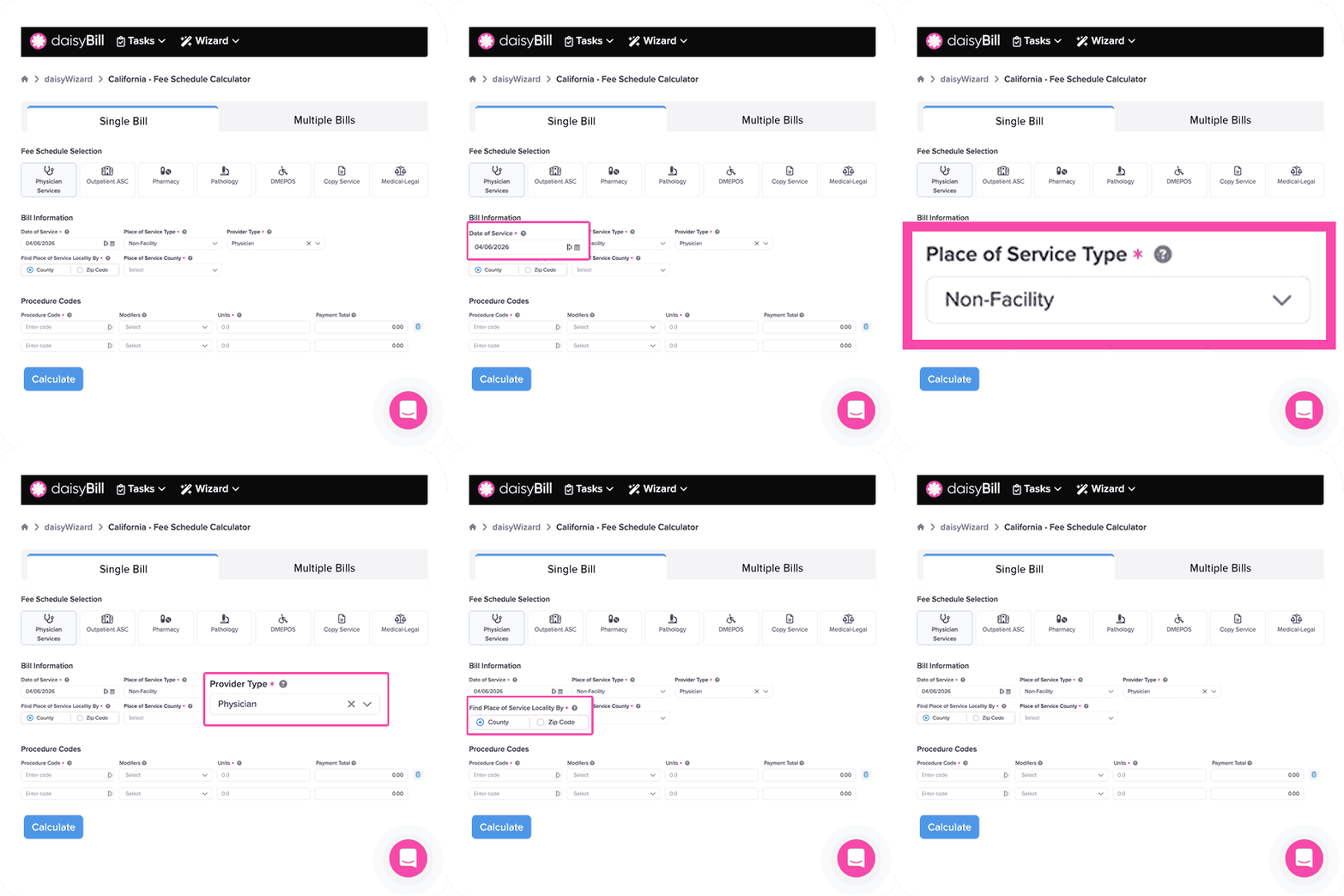
daisyBill keeps track of every bill and payment, with automated ‘Task’ prompts for each step of the process. Click below to see more:
BILL BETTER: DAISYBILL


DaisyBill provides content as an insightful service to its readers and clients. It does not offer legal advice and cannot guarantee the accuracy or suitability of its content for a particular purpose.

Sad but true. And despite such successful outcomes, interpreters must continue requesting IBR over and over again often on the same claims, and certainly involving the same claims administrator. The interpreter community has proposed solutions to these wrongs, and only time will tell whether they get implemented into upcoming regulation updates. Meanwhile, interpreters are left with an onerous, albeit successful, pathway to recover what is rightfully owed. Unfortunately, many many practicing interpreters have neither the wherewithal nor the resources or knowledge to pursue their small balances, leading to a windfall of savings for payors of legally mandated language access for limited English proficient injured workers.