CA Employers Need to Know: Is It the Injury or the UR System?

Last year, California raised employers’ workers' comp premiums by 8.7% while other states continued to cut rates, some for over a decade straight. Across the nation, premiums are down as comp costs fall and insurer profits rise.
So why is California the rare exception?
According to the Workers’ Compensation Insurance Rating Bureau (WCIRB) and the state’s Insurance Commissioner, the answer is rising medical costs. But the data tell a different story entirely. California's workers' comp fee schedules are among the lowest in the nation, and insurers are reporting healthy loss ratios.
According to the WCIRB, it costs 51 cents to deliver every dollar of benefits to a California injured worker, nearly double the national median. The difference doesn't fund treatment; it goes to payers, vendors, and the private equity firms invested across the process.
Behind all of it is a foundational problem: California employers have no way to evaluate the system they're funding. They can't determine whether their injured employees are failing to return to work due to a genuine medical condition or because a payer is systematically denying care, inflating disability costs, and extending claims for profit.
A clear view into the system requires hard data on Utilization Review (UR), the process by which payers determine whether to approve the care recommended by an injured worker’s physician. The California Division of Workers’ Compensation (CA DWC), the state agency legally required to collect UR data, has refused to do so for nearly a decade, despite two separate legislative mandates.
Instead, the CA DWC has spent over $1.5 million commissioning toothless studies on nonexistent data. Until that changes, California employers will keep paying more for a system they cannot audit, question, or trust to spend their premium dollars efficiently.
The Question CA Employers Need Answered
When an injured worker fails to return to work promptly, there are generally two possible explanations. Each carries very different implications for an employer's costs and liability.
- The worker received timely, appropriate care and is simply taking longer to heal.
- The worker couldn't access care because treatment requests were delayed or denied through UR. While they waited, their condition worsened, disability payments accrued, an attorney entered the picture, and a manageable claim became a multi-year liability.
A single 45-day UR authorization cycle adds about 6 weeks to a claim. It generates roughly $5,490 in Temporary Total Disability (TTD) for a worker earning California's average weekly wage of $1,373, before a provider renders a single treatment. Over three cycles, disability costs alone can exceed $16,000, potentially multiples more than the medical treatment required.
Add a Medical-Legal evaluation, defense counsel, and deposition costs, and the system sold to employers as "cost control" has become prohibitively expensive.
California employers currently have no way to know which of the two scenarios above is really playing out. The data are waiting to be collected, but the state agency responsible for collecting it has refused to do so, in blatant violation of the law.
CA DCW Ignores Law, Performs “Research”
In 2016 and again in 2019, California legislators mandated UR data collection through Senate Bill 1160 and Senate Bill 537.
The laws were clear: the CA DWC must build infrastructure for mandatory electronic reporting of every UR document from every payer in the state, publish provider utilization data, and commission an independent study on medical treatment in the first 30 days of a claim to be published by July 1, 2023.
None of it happened. There is no UR database, there are no published UR statistics, and the study was never commissioned.
Instead of collecting the statewide UR data the law requires, the CA DWC conducts what can only be described as performative audits, reviewing a statistically meaningless handful of Requests for Authorization (RFAs) that tell stakeholders nothing actionable.
The most recent UR audits analyzed just 1,772 RFAs statewide across all of 2024 and 2025. For context: in those same two years, 573 providers using daisyAuth submitted 429,015 RFAs to payers across California. The CA DWC reviewed less than 0.5% of that volume. For Sedgwick alone, daisyBill clients submitted 95,346 RFAs in 2024 and 2025; the CA DWC audited UR decisions on just 249 of them.
Data from daisyAuth for the first seven months of 2024 covered 267,317 treatment requests from 367 providers for over 50,000 injured workers. As we noted at the time, only 71% of treatments were approved, with 22% outright denied. Among individual payers, denial rates ranged from 3% to 46%, strongly suggesting that UR decisions depend more on which payer makes the UR decision and less on the medical merits of the request.
The CA DWC is not only failing to collect this data; it is spending taxpayer money to study the gaping void where the data should be. In April 2025, the Department of Industrial Relations (DIR) awarded RAND Corporation $300,000 to study UR data on injured workers' access to care, data that the CA DWC never collected. Neither of the databases RAND was directed to use contains UR approval, modification, or denial data.
Then, in October 2025, the DIR issued a Request for Proposal for a $1.25 million "Medical Access Study," directing researchers to draw from incomplete (and “voluntary”) Workers’ Compensation Information System (WCIS) data, dysfunctional Medical Provider Network listings, and surveys.
A software company has more actionable UR data than the state agency legally required to govern the process. As we have before, we invite the CA DWC to study daisyBill's data in anonymized form.
The WCIRB Is Not on Employers’ Side
The entity primarily responsible for demanding 8.7% more in premiums from California employers is the WCIRB, an organization whose data come directly from the insurers who benefit from higher rates.
Independent observers have noted that the WCIRB systematically understates insurer profits, uses an inflated definition of "medical costs" that includes non-medical expenses like Medical-Legal disputes, and ignores the deep discounts that keep actual provider reimbursement well below published fee schedules.
Other independent rating bureaus across the country looked at market conditions and cut rates. The WCIRB reached the opposite conclusion. California employers are paying a bill calculated by the industry that stands to profit from the bill.
Demand Answers…Or Keep Overpaying
Without UR data, no one can prove which payers are systematically denying care, extending claims, and driving up employer costs. Payers operate in the shadows, the WCIRB justifies rate increases without scrutiny, and the research gravy train rolls on ($300,000 here, $1.25 million there), producing studies that can’t answer the questions that matter most.
California employers need to demand answers. Specifically:
-
Why has the CA DWC refused for nearly a decade to comply with state law requiring mandatory UR data collection, and what will new CA DWC leadership do about it?
- Which TPAs managing their claims have the highest denial rates, and what’s the impact on claim durations, disability costs, and experience modification factors?
- How does the WCIRB justify premium increases when insurers are profitable, fee schedules are low, and the data underlying its methodology has never been subject to independent scrutiny?
Without UR data, employers cannot know whether medical need, administrative dysfunction, or private equity profit is keeping their employees out of work.
Without accountability, the current arrangement, in which payers, vendors, and private equity profit from keeping claims open, the WCIRB certifies the bill, and the CA DWC “studies” data it won't collect, will continue indefinitely. California employers will keep absorbing the cost.
The laws are already on the books. All that's needed is an employer community unwilling to accept another premium increase without a reliable, data-based justification.
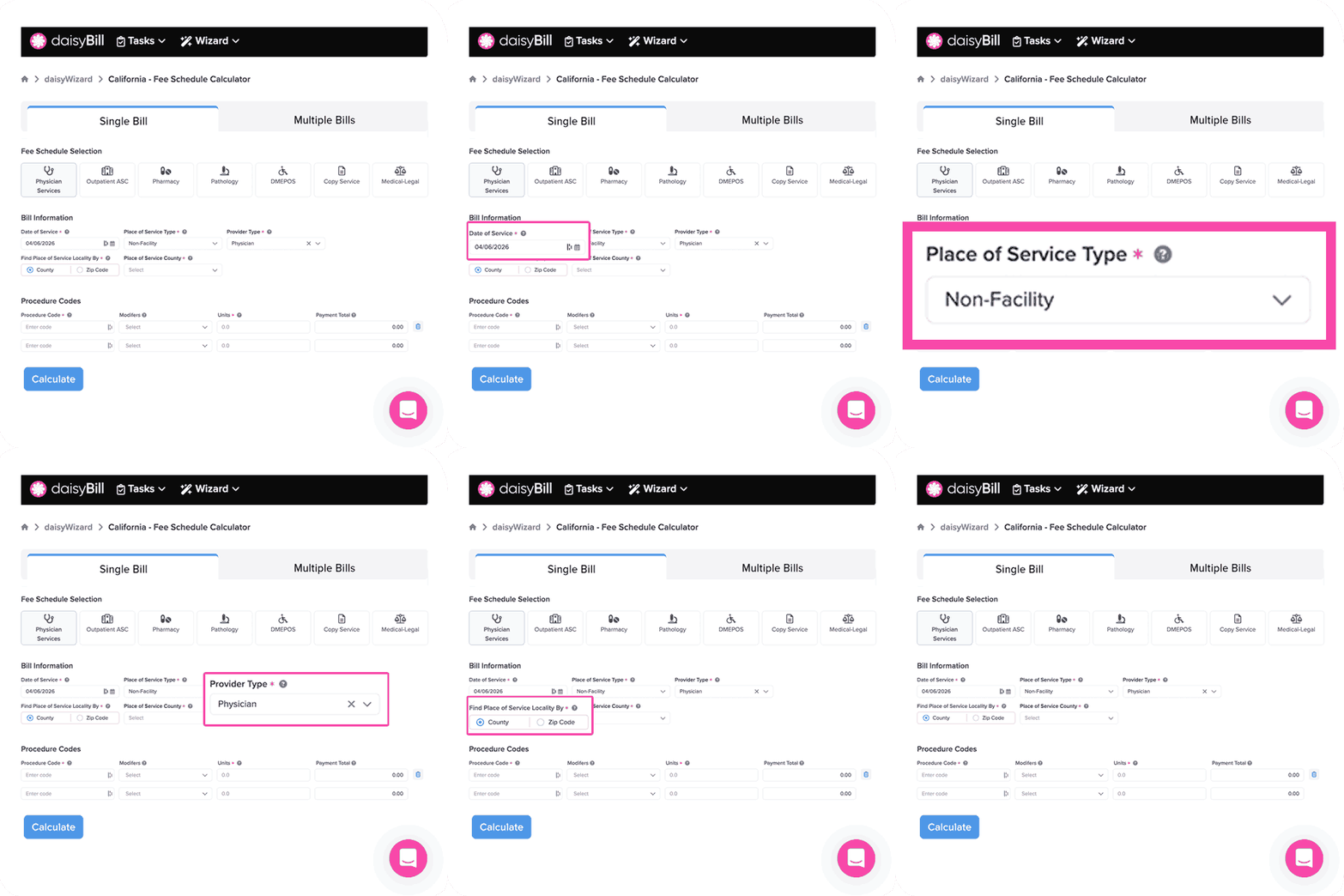
daisyAuth submits compliant RFAs in seconds, and tracks the payer’s response so you always know where your treatment request stands. Click below to learn more:
LEARN MORE: DAISYAUTH

.gif)
DaisyBill provides content as an insightful service to its readers and clients. It does not offer legal advice and cannot guarantee the accuracy or suitability of its content for a particular purpose.
.gif)